Slate or acrylic house number
You are choosing the face of the house number, not the whole comparison. A 1930s semi and a new rendered wall do not want the same surface, and neither slate nor acrylic has a weathering test in this set. This page holds that fork: what each face is, how heavy it is, how the characters are made, and which front it suits. There is no single winner. The twelve-row table is the [house number comparison](/hub/garden-decor/house-number). Shops that say both materials last ten to twenty years are talking about their own stock. That lifespan is not adopted for these ASINs.
You are choosing the face of the house number, not the whole comparison. A 1930s semi and a new rendered wall do not want the same surface, and neither slate nor acrylic has a weathering test in this set.
You are choosing the face of the house number, not the whole comparison. A 1930s semi and a new rendered wall do not want the same surface, and neither slate nor acrylic has a weathering test in this set. This page holds that fork: what each face is, how heavy it is, how the characters are made, and which front it suits. There is no single winner. The twelve-row table is the house number comparison. Shops that say both materials last ten to twenty years are talking about their own stock. That lifespan is not adopted for these ASINs.
Our top picks
| Badge | Product | Material | Weight | Characters | Note | Price | Offer |
|---|---|---|---|---|---|---|---|
| Best overall |  K Smart Sign Modern glass-effect acrylic house plaque | Acrylic, steel | 240 g, 15 mm | Surface print | 9.6 | about £7.99 | View offer |
 EDSG EDSG natural slate house plaque | Natural slate | 410 g, 4–6 mm | UV print | 9.2 | about £13.99 | View offer | |
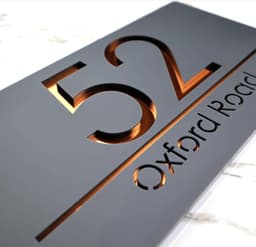
 K Smart Sign K Smart Bellisima plaque, copper mirror | Acrylic, mirror back | 300 g | Laser-cut | 9.0 | about £14.99 | View offer |


On this page
What each face is in this set
Weight, thickness, and the size conflict
Print, cut-out, and peel
Which front it suits
Common questions
Which listing in this set is the slate plaque?
Is slate thicker or heavier here than the acrylic plaques?
Do acrylic letters stay white?
What does composite aluminium mean on the Exalted board?
Is a laser-cut mirror back the same material as a printed acrylic face?
Will slate or acrylic fade?
Related pages
Sources
Advertisement consent, numeral size and numbering powers are from the UK sources below. amazon.co.uk prices, stars and review counts are the twelve listings in this comparison. This is not a laboratory test.
- Town and Country Planning (Control of Advertisements) (England) Regulations 2007, Schedule 3, Class 2A (retrieved 22 October 2026)
- Planning Portal, adverts and signs (retrieved 22 October 2026)
- GOV.UK, advertisements (retrieved 22 October 2026)
- Department for Transport Circular 3/93, Appendix C (retrieved 22 October 2026)
- Towns Improvement Clauses Act 1847, section 64 (retrieved 22 October 2026)
- Town and Country Planning (Control of Advertisements) (Scotland) Regulations 1984, Schedule 4 (retrieved 22 October 2026)
- Consumer Contracts (Information, Cancellation and Additional Charges) Regulations 2013, regulation 28 (retrieved 22 October 2026)
- Consumer Rights Act 2015 (retrieved 22 October 2026)