Independent comparisons. We may earn from shop links. More info

How to use a pickaroon

Updated: 22 October 2026

The spike is in your hand, or it will be when the parcel arrives, and the round is either on the ground or in a store that is too tight for a long bar. You need a sequence you can repeat: set the point, move the wood a short way, get the point out, and stop if the head moves. This is how to use a pickaroon without a ranking of the twelve. The [pickaroon comparison](/hub/forestry-tools/pickaroon) is where those listings and prices sit. If the handle is simply the wrong length, that is a buying choice, not a harder swing. Peter F. mapped these steps from the listings and HSE guidance, and did not swing the tools. A qualifying purchase can earn a commission at no extra cost to you.

The spike is in your hand, or it will be when the parcel arrives, and the round is either on the ground or in a store that is too tight for a long bar.

Our top picks

Fiskars Fiskars 28 inch hookaroon

Best overall

Fiskars Fiskars 28 inch hookaroon
9.6/10about £51.41
Oregon Oregon 536319

Rank 2

Oregon Oregon 536319
9.4/10about £79.99
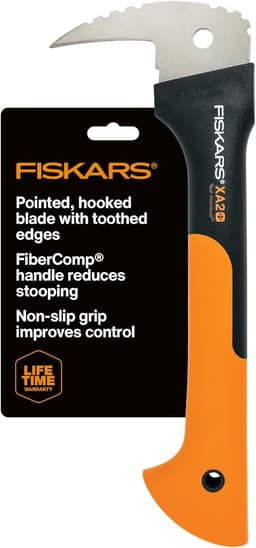
Fiskars Fiskars 12 inch hookaroon

Best value

Fiskars Fiskars 12 inch hookaroon
9.2/10about £31.02
On this page

Before the first swing

Read the length and the weight of the tool you actually own before you take any cover off. A 272 g Fiskars 12 inch and a 1.56 kg Kings County pick do not ask for the same commitment when you miss. Check the head for play. On hung hickory, the shared Forester reviews and the Kings County US reviews are why that check is not fussiness: a head loosened, a handle split on first use, and in two Kings County reports the head broke off. On a one-piece bar there is no eye to wiggle, and the fault to look for is a point that will not bite. If a sheath came in the box, which in this set means the Fiskars 12 inch or the WoodXpert, leave it on until you are standing where you will work. UK reviews of the WoodXpert leave the case behind because it is too bulky to carry, so you still need a stump or a hook for the spike. Health and Safety Executive guidance on manual handling in agriculture is not a pickaroon manual. It does say to know the route, keep the load close, and avoid twisting while you are bent. Clear your feet, and clear the chainsaw if it is still on the ground.

Set the point

Use a short swing into end grain or into a sound face, not a chop at bark you have not looked at. UK reviews of the Oregon 50 cm pick say end grain makes sizeable chunks easier to lift. A US review of the same tool says it will not enter oak splits except at end grain. Fiskars 28 inch reviews name the toothed beak as the hold when the hit is clean. The Ochsenkopf UK review says the angle has to be learned, and that the tool suits cord-length rounds rather than stabbing splits and then lifting them. If the point skates, change the face. Do not answer a miss by swinging harder, especially with the Dolibest at 1.36 kg or the Kings County at 1.56 kg. Those reviews say a miss is something you regret. There is no official swing angle in degrees for this tool, so this page will not invent one. If it will not bite, change face or stop.
Fiskars Fiskars 28 inch hookaroon

Testsieger

Fiskars Fiskars 28 inch hookaroon
9.6/10about £51.41

Move the wood and get the point out

Once the point is in, drag, roll, or flick the piece a short distance. Reviewers talk about moving a round onto a splitter, rolling a trunk, or pulling firewood out of a pile. They are not describing a carry across the yard on the spike. Hooking is not a carry. The Health and Safety Executive screens an easy, close lift at about 25 kg and still wants smaller pieces and shorter carries. A wet round that your pick has entered weighs what it weighed before the point went in. To release, twist or change the angle rather than yanking straight back along the handle. A Canada review of the short KOXHERO says getting the hook out takes practice. If you are holding a split while you hatchet kindling, as Fiskars 12 inch reviews describe, keep the spare hand out of the hatchet’s path. One Oregon review says not to grind the tip into a needle, and to think of a pulp-hook edge instead. That is one user’s report, not a grind specification. Sheath the tool, or hang it, before you start the next cut.

When to stop

Stop when the head moves. The Forester UK review says the head loosened quickly and nearly came off. Two UK reviews of the Fiskars 28 inch say the tip broke or sheared and then would not stick. A loose head is not a wedge you tap later in the middle of a pile. At work, the Provision and Use of Work Equipment Regulations 1998 require a suitable, maintained tool and a user who has been told how to use it. This hand tool is not what the forestry LOLER page covers. That page is about machines. You do not book a lifting-equipment examination because you own a pickaroon. Stop and get help when the tree is hung or under tension, when a stack has shifted, or when the round is more than you can move without twisting. The Health and Safety Executive’s sheet on stacks says to keep people off log stacks, to wedge the logs, and to hold stack angles to 45 degrees, or 35 degrees if people remain nearby. That figure is about the stack, not about the arc of your swing. If the tool is simply too short for the floor or too long for the store, that belongs on the pickaroon buying guide. The firewood jobs are on pickaroon for firewood.

Common questions

Where do I stick the point, end grain or bark?
Start at end grain or at a sound face you can see, with a short swing. UK reviews of the Oregon say end grain makes a sizeable chunk easier to lift, and a US review of that same pick says oak splits will not take the point except there. Bark on a dirty round often lets the tip skate. If it skates, change the face. There is no published degree for the swing, so copying a number from a forum will not make the hit more reliable.
How do I get it out again?
Twist or roll the handle so the point leaves on a different line from the one that drove it in. Yanking straight back is how a buried tip stays put, and a Canada review of a short hooked pick says release takes practice. Put the wood down first, then work the point free. One Oregon user says not to sharpen the tip to a needle. That is a single review, not a specification, and a needle that holds too well is harder to remove.
Can I carry the round once it is hooked?
You can move it a short way by dragging or rolling. Carrying it because the spike is in is a different job, and the tool has not changed the weight. The Health and Safety Executive screens an easy, close lift at about 25 kg and still wants smaller pieces and shorter carries. A wet hardwood round often fails that screen. Put it down, then lift with a better hold, or split it, if the hooked carry would mean twisting while you are bent.
What do I do if the head moves?
Stop. The shared Forester reviews include a UK report that the head loosened and nearly came off, plus handles that split or snapped in the eye. Two UK reviews of the Fiskars 28 inch describe a tip that broke or sheared. Do not finish the pile and plan to look tonight. At work, a loose head means the tool is no longer suitable until it is repaired or replaced. A rehang you are not equipped to do is a reason to get help, not a lunchtime project on the driveway.
Do I need a sheath between the pile and the shed?
Only the Fiskars 12 inch and the WoodXpert state a sheath or a case in this set. If yours came with one, use it for the walk. UK reviewers find the WoodXpert case too bulky to wear while they work, so they still need a place to park the spike at the block. If the listing included nothing, you need a hook, a stump you trust, or a cover you add yourself. Leaving the point bare in a path is how it meets a boot.
Is this tool covered by LOLER?
The forestry page on LOLER is about machines used to lift, not about this hand spike. You do not put a pickaroon through a thorough examination under that regime just because it hooks a log. At work, PUWER still applies: the tool has to be suitable, kept that way, and used by someone who has been instructed. A domestic stove pile is not that workplace duty, and a loose head is still a reason to stop in either setting.
When should I stop and get help?
Get help when the timber is hung or under tension, when a stack has shifted, or when the round is more than you can move without twisting. Stack guidance from the Health and Safety Executive is to keep people off log stacks and to wedge what you leave standing. Also stop if the head needs a rehang you cannot do, or if a workplace has not checked the tool under PUWER. A pick that will not bite is a reason to change face or change tool, not to swing a 1.3 kg bar harder.

Related pages

Sources

Public sources from the research digest. Shelf prices are the amazon.co.uk figures in the saved listings of 19 October 2026.

  1. HSE: Manual handling in agriculture (retrieved 22 October 2026)
  2. HSE: Safe working with timber (WIS2) (retrieved 22 October 2026)
  3. HSE: PUWER overview (retrieved 22 October 2026)
  4. HSE: LOLER and forestry (retrieved 22 October 2026)
  5. Consumer Rights Act 2015, section 9 (retrieved 22 October 2026)
  6. Ochsenkopf OX 172 A-0500 (retrieved 22 October 2026)
  7. Oregon lifting pick 536319 (retrieved 22 October 2026)
  8. Arbtalk: lifting tongs and a hookaroon (retrieved 22 October 2026)