Independent comparisons. We may earn from shop links. More info

How to use a kindling splitter without the first blow going wrong

Updated: 22 October 2026

How to use a kindling splitter starts with the base, not with a heroic strike. The usual first mistake is a loose tool, a hand still on the wood, or a guide rod that is not seated. This page is the order of work for a ring, a mounted chisel, a driven wedge, and the Forest Master drop-hammer. The table is the [manual log splitter comparison](/hub/forestry-tools/manual-log-splitter). Peter F. read the listings and the handbook notes and did not lab-test the tools. A qualifying purchase can earn a commission at no extra cost to you.

How to use a kindling splitter starts with the base, not with a heroic strike. The usual first mistake is a loose tool, a hand still on the wood, or a guide rod that is not seated.

Our top picks

On this page

Fix the base before the first blow

A loose ring walks on the first heavy blow, and the King does this too until it is screwed to a large log. West Country Stoves prints a level stump, then the log, then a tap, then the hand away, then the strike. A patio slab is a poor anvil. SPARES2GO's screws were too short for some stumps. Do not split while the casting is loose. This is still a hammer.

Ring tool: tap, then strike

Hit the wood, not the iron. Stand the log in the ring, tap it until it seats, take your hand off, then strike. Original buyers name a 4 lb or about 2 kg lump hammer. A claw hammer is the wrong face, and the hammer is not in the box. Knots catch. Hitting the same knot harder bounces the log out, so turn it or stop. The King still halves rather than quarters. Fandango's limits are about 16 cm and about 22 cm. If the log will not enter, stop. Keep children away from the hammer.

Mounted chisel and driven wedge

On a screwed chisel the edge is fixed: place the wood, take the hand away, strike the wood. SPARES2GO reviews file paint off before the log will bite. The FM9LS chips on early logs, and a loose cover is storage, not a guard. The Rolson is different. You hit the wedge. Set it in a crack or in end grain and drive it with a sledge. There is no ring. If it sticks in the centre, knock it back or start in a crack. Do not keep hitting a head you cannot see square.

Drop-hammer: different rules

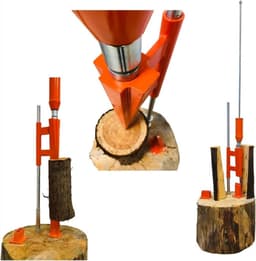
The FMSS is not a mallet. Drill, fit the guide, and lift the weight. The handbook wins: a block at least 35 cm high and across, a 20 mm hole about 12 cm deep. Only people over 16, with others at least 3 m away. Do not hold the log under the raised weight. If the rod lifts out, stop. One review describes the head striking the user. A cracked part is a stop.

When to stop

Turn a knot or reject it. A piece jammed in the MEEPOCAN frame comes out by relieving the wood, not by striking the frame. File paint off a bouncing edge and tighten the base. A chipped edge and a loose FMSS guide are stops. Stop if you are about to fell, if a part is cracked, or if the guide will not stay seated. If the opening is simply too small, that is a buying mistake on the buying guide. Powered processors in the HSE bulletin are a different machine.

Common questions

What is the order of blows on a ring tool?
Fix the ring so it cannot walk. Stand the log on the wedge, tap it until it sits, take your hand away, then strike the wood, not the iron. Repeat on the halves. If the piece will not enter the ring, stop using that ring for that piece.
What hammer, and why not a claw hammer?
Reviews cluster around a 3–4 lb club hammer or a lump hammer of about 1.5–2 kg. A claw hammer is light, and the claw is the wrong face. The Rolson is specified for a sledgehammer. None of the ring or chisel boxes includes the hammer. The FMSS is its own weight, on a guide.
Do I have to bolt it, even the heavy King?
Yes, if you want the stable setup the reviews describe. The King still wobbles until it is screwed to a log. A loose tool takes the log with it. The FMSS is different: its guide goes into a drilled hole, and that hole has to hold.
How do I set up the FMSS so the head does not slide out?
Follow the handbook: a block at least 35 cm by 35 cm, a straight 20 mm hole about 12 cm deep, and thread lock left as long as the booklet says, up to 24 hours. Check the rod stays seated when you lift. If it lifts free, stop. One buyer was hit when the guide came out.
What do I do when the log bounces?
On a mounted chisel, bouncing is often paint or a blunt edge, which SPARES2GO reviewers file off, plus a base that is not tight. On a ring, re-seat the log, take the hand away, and strike square. If it still will not start, the piece is the wrong wood. A wilder blow is how the log leaves sideways.
What do I do when a piece jams in the frame or on a knot?
Change line or reject a knot. Do not keep hitting the same spot. A piece jammed in the MEEPOCAN frame needs the wood relieved, not a blow on the frame. A Rolson buried in the centre is the same stop: knock it back or start in a crack.
When do I stop and not hit harder?
Stop when the guide is loose, the edge is chipped, the knot has not moved, or the log will not enter. Stop if a part is cracked, if someone is inside the FMSS 3 m line, or if the person lifting is under 16. Hitting harder turns a stuck wedge into a miss. If the tool is too small, change the tool.

Related pages

Sources

Public UK sources from the research digest, last checked on 22 October 2026.

  1. HSE: firewood processing machines, OPSTD 2-2011 (retrieved 22 October 2026)
  2. BSI: BS EN 609-1:2017 wedge-splitter safety (retrieved 22 October 2026)
  3. General Product Safety Regulations 2005 (retrieved 22 October 2026)
  4. GOV.UK: General Product Safety Regulations 2005, Great Britain (retrieved 22 October 2026)
  5. Fandango Fire Tools: Kindling Cracker Original (retrieved 22 October 2026)
  6. Fandango Fire Tools: Kindling Cracker King (retrieved 22 October 2026)
  7. Forest Master FMSS log splitter handbook (retrieved 22 October 2026)
  8. GOV.UK: selling wood for domestic use in England (retrieved 22 October 2026)