Polyester flag fabric weight: gsm, denier and grams
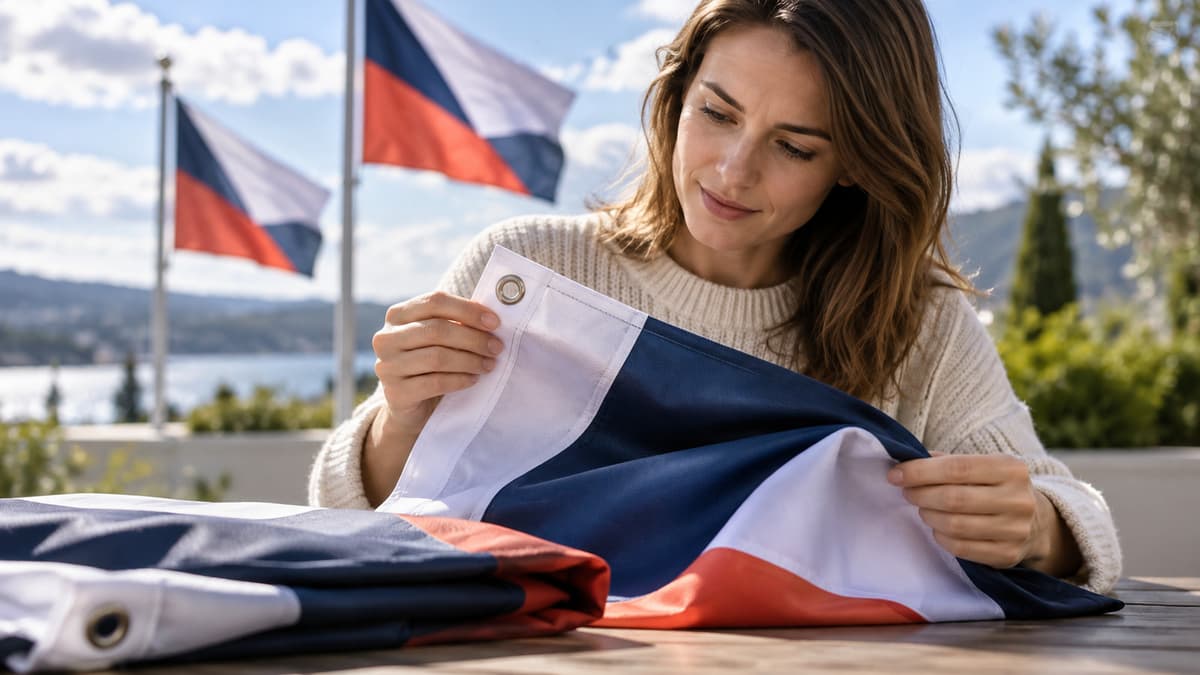
Gsm is the weight of the cloth and denier is the yarn. How to read a polyester flag listing that only says 150D, and why the gram total is a different figure.
On this page

Two polyester flags can look the same in a thumbnail and behave differently on a pole, because polyester flag fabric weight is doing more work than the word polyester admits. One listing talks in grams per square metre. Another says 150D. A third prints 100 g and a wash line. Those are three measurements, and only one of them is the weight of the cloth.
You need the fibre and, if the page has it, the gsm, before denier is useful. Heinrich W. used UK maker guides from Flagmakers, Flag Studio, and Union Flag Company, plus the amazon.co.uk listings already captured in our flag comparisons, in October 2026. We did not weigh the cloth in a lab. A qualifying purchase through our links can earn us a commission at no extra cost to you.
In short
Gsm is grams per square metre of flag cloth. Denier is a yarn count. Knitted polyester in UK maker ranges sits around 110 to 115 gsm, and woven polyester often around 150 to 155 gsm. A listing that only says 150D has not stated a gsm, and the gram weight of the packed flag is a different number again.
Grams per square metre and denier
Gsm answers how much a square metre of that cloth weighs. Flag Studio defines it that way, and defines denier as the thickness of the thread. A higher denier means a thicker yarn. It does not, in the same sentence, mean a heavier square metre. Makers who print both numbers can be compared. A page that prints only one of them is an incomplete specification, which is the normal state of many amazon.co.uk flag titles.
UK flag houses work in gsm because that is the number that tracks how the cloth flies and how it wears in their own cutting rooms. Flagmakers stock 115 gsm knitted polyester for printed flags, 150 gsm woven or spun polyester as the heavier traditional cloth, and a still heavier 205 gsm Decotex. Flag Studio's printed-flag example is about 115 gsm knit, and its Ministry of Defence-grade woven polyester is described as typically 155 gsm or more. Union Flag Company puts knitted polyester usually around 110 gsm and woven polyester often at 155 gsm or more. Those ranges are the makers' working cloths. They are not a British Standard, and they are not a test of the ASINs below.
There is no honest conversion from a lone denier figure to a gsm figure. If the listing prints both, use both. If it prints neither, you are choosing on fibre, size, care, and price, and you should say so to yourself before you treat two polyester flags as the same product. Stitching and the header matter as well as weight. A light cloth with a failed sleeve is a short-lived flag for a reason gsm never mentioned.
Knitted polyester around 110 to 115 gsm
Knitted polyester is the cloth UK makers describe for a printed flag that should move in ordinary wind. Flagmakers put their printed work on 115 gsm knit, and they describe dye-through as about 95 percent of the face, so the design is visible when the flag turns. Union Flag Company calls knitted polyester the general outdoor printed flag, usually around 110 gsm. The band is narrow in their catalogues. A listing that says knitted polyester without a gsm is pointing at that kind of cloth and then stopping short of the number.
The practical point is wind. Knit is described as flying in lighter air than a woven flag of the traditional weight. On a short wall pole, or in a garden with houses on three sides, that is often the cloth that actually moves on a weekday. It is also the cloth a UK printer, talking about its own knitted polyester, tells people to take down earlier in a rising wind. Life depends on climate and hours flown. A lighter flag that stays up through every gale does not collect the long life a heavier cloth is sold on.
Do not promote a knit to "the outdoor flag" for every site. An exposed coastal pole, or a flag left up for months, is where makers start talking about a heavier weave and about bringing the flag in. The Borussia Dortmund flag comparison includes an official polyester hoist flag, 150 cm by 100 cm, listed indoor, machine wash, about £10.97, 100 g on the listing, 4.6 from 162 reviews. Buyers describe it on flagpoles and in gardens. The page itself says indoor and room use. That clash is the listing, not a gsm we measured.
Woven polyester, and when heavier cloth hangs
Woven polyester is the heavier traditional flag in the maker guides. Flagmakers' 150 gsm woven or spun polyester is the cloth they say needs more wind to fly. Flag Studio's heavy woven example starts at 155 gsm or more. Union Flag Company makes the same split and adds the limit that matters in a small garden: a very heavy cloth on a short, sheltered pole may rarely fly. Weight is not a ladder where the next step is always better. It is a trade between fly, wear, and the wind you actually have.
Flagmakers state their own commercial trade-off in plain figures: a woven flag typically costs about 30 percent more, and its life can be at least 50 percent longer. Keep that sentence attached to Flagmakers. It is not a result for the official Borussia Dortmund polyester flag, and it is not a result for a 150D print. We did not run the fade test or the flight test that would let us move those percentages onto an ASIN.
If your pole is a 1.5 metre wall bracket in a side alley, a 150 gsm weave can be the flag that looks smart in the photograph and hangs on the days you wanted it seen. If the pole is tall and the garden is open, the same cloth is what the makers are describing when they talk about harder use. Look at the header and the stitching either way. A heavier body on a thin sleeve still tears at the attachment, which is the failure reviewers describe on flags that were sold as outdoor.
A 150D line, item grams, and viscose
Desert Cactus prints in the Borussia Dortmund comparison state 150D polyester, a hand-wash line, and an item weight of 181 g, at about £35.80 to £37.86, with one to three reviews or none. 150D is denier. The digest does not contain a gsm for those pages, and there is no sourced conversion. Calling 150D "150 gsm" is a slip of the letter D, not a calculation. A higher denier is a thicker thread in that counting system. It does not tell you how dense the weave is, and it does not tell you how long the flag lasts.
Item weight is the other trap. The official polyester flag's 100 g, and the official viscose flag's 100 g, are listing weights for the finished item. The viscose flag is 150 cm by 400 cm, which is 6 square metres. Dividing 100 g by 6 square metres gives about 17 gsm. That sum is a check on the listing, not a fabric specification. It does not match any of the maker cloths from 110 gsm upward. The conflict is the point. A 3 ft by 5 ft class of flag at 181 g is still not a gsm, because the packet weight includes header, stitching, and fittings, and because the page never printed grams per square metre.
How to read an amazon.co.uk flag page
Common questions
What does gsm mean on a flag?
Is 150D the same as 150 gsm?
Is knitted polyester or woven polyester better outdoors?
Why would a heavier flag fly worse?
The listing says polyester and 100 g. Is that the fabric weight?
Is viscose the same as polyester for weight and washing?
Does a higher denier mean a longer life?
What should I do if the amazon.co.uk page never states gsm?

Heinrich W. is the editor for Leisure & sport at productscompared.co.uk. Comparisons in this category are checked against amazon.co.uk listings, review evidence and public UK sources.
Related articles

When to take a flag down in wind: lower it in time
Light cloth and a missing wind figure are reasons to follow the earlier warning.

How to wash a polyester flag
Machine wash, hand wash, and a cold wash are different care lines. Follow the listing.
Single-sided or double-sided flags
A mirrored back is normal on one layer. A second layer changes the weight outdoors.