Independent comparisons. We may earn from shop links. More info

Hydrangea compost for pots: mix, size and watering

Updated: October 2026

On a paved patio, or in a garden with chalky soil, a container lets you manage the hydrangea's roots without trying to change the whole border. Choosing hydrangea compost for pots is still two decisions: whether blue flowers need an ericaceous mix, and how much bagged medium you can use, lift and store. A bold 50 L title is not a reliable pot-volume calculator, especially when the listing gives another litre figure. Our [hydrangea soil comparison](/hub/fertiliser-soil-and-bark-mulch/hydrangea-soil) shows those conflicts. This page takes you from the colour goal to pot size, drainage, bag choice and a watering routine for a hard-water area.

On a paved patio, or in a garden with chalky soil, a container lets you manage the hydrangea's roots without trying to change the whole border.

Our top picks

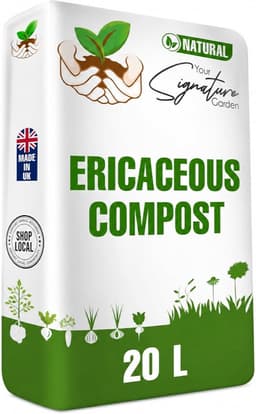
Laeto Laeto Ericaceous 20 L

Alternative

Laeto Laeto Ericaceous 20 L
9.2/10about £11.54
On this page

Two pot mixes for two colour goals

Use peat-free ericaceous compost when you have a colour-changing mophead or lacecap, want it blue, and need to keep the roots off alkaline ground. It cannot force a white, panicle or arborescens hydrangea to turn blue. Where blue is not the goal, the RHS suggests two parts peat-free John Innes No.3 to one part peat-free multi-purpose compost. Gardeners' World similarly favours a loam-based John Innes mix for a shrub that stays in a pot. The loam adds weight and moisture retention, and a large pot is harder to move. SIC states peat-free and pH 4.0. The indigo item-type field says peat-free and gives no number. Laeto names hydrangeas and states neither. How to separate those claims is in the ericaceous compost buying guide.

Choose a stable pot with working drainage

A small shrub generally needs a container around 45 cm across, though cultivar, rootball and pot shape still matter. Choose a compact hydrangea if the pot cannot grow. A broad pot is less likely to topple when wet flowers catch the wind. Drainage holes must be open. Raise the pot on feet if water pools on the patio, and do not fill the base with a deep layer that steals root space. Repot at the same depth as the nursery container, with watering space below the rim. Loosen circling roots gently, water thoroughly, and empty a saucer once the rootball has drained. A 45 cm pot of moist loam and a mature shrub can be hard to move. Put the empty pot in place first, or use a wheeled base rated for the load. Open-ground planting is the hydrangea planting guide.

Match bag size to the job, not a guessed pot volume

A nominal 20 L bag does not fill a pot of a given diameter. Taper, depth, the rootball and the watering gap all reduce how much fresh compost you need. Every title litre here conflicts with another volume field. Laeto's 20 L title is the small sack, at £11.54 and 3 kg. The technical field says 10 litres, about 58p per title litre, so do not promise one complete repot until you see the bag. TerraGrade was £9.99, SIC and Green Haven £12.49, Laeto 50 L £13.79 and indigo 46 L £14.99. Listed weights run from 6 kg for Laeto 50 L to 14.9 kg for TerraGrade. Weight helps with carrying. It does not convert reliably to litres. Laeto's 100 L title sits beside a 40 litre field and 8.44 kg. At £26.99 the title-litre rate is about 27p, using an unverified quantity. Sack roles are compared in best ericaceous compost by job.

Use rainwater, but never trade it for drought

Containers dry faster than open ground. Check moisture below the surface, especially in warm spells and while flowers are open. Water slowly until some drains from the base. Light splashes can leave the centre dry. Rainwater is preferable for a blue hydrangea, because hard mains water raises the pH of a lime-free mix. If the butt is empty, use tap water rather than let the plant wilt. Keep mulch off the stems. Water that runs straight down the pot edge can mean a dry, shrunken rootball. Persistent saturation suggests blocked drainage. Repot when roots circle densely, water misses the centre, or the compost has collapsed. Do not cover the crown.

Common questions

What compost should I use if I do not want blue flowers?
For a long-term container where blue is not the goal, the RHS suggests two parts peat-free John Innes No.3 to one part peat-free multi-purpose compost. This loam-based mix suits a shrub better than buying ericaceous compost solely because the label names hydrangeas.
What compost supports blue flowers on chalky ground?
Use peat-free ericaceous compost in a container for a responsive mophead, lacecap or suitable serrata cultivar. The pot isolates roots from alkaline soil more effectively than an acid pocket in a chalk border. Rainwater and continuing pH management still matter. Compost alone cannot guarantee blue.
Is a 20 L bag enough for one hydrangea pot?
It depends on the pot's internal shape, the existing rootball and the headspace left for watering. Do not use diameter alone to invent a volume. The Laeto 20 L title also conflicts with a 10 litre technical field, so check the delivered bag and keep a small margin.
Do I need crocks in the bottom?
You need open drainage holes, not a thick crock layer. Mesh, or one curved piece over a large hole, can stop compost escaping without blocking water, but filling the base with rubble reduces root space. Raise the pot if water pools beneath it, and empty standing saucers.
Can I use tap water in a hard-water area?
Yes when rainwater is unavailable. Hard tap water gradually pushes an acid mix towards alkalinity, so rainwater kept in a water butt is preferable for blue flowers, but a dry hydrangea is the greater immediate risk. Water thoroughly with tap water rather than withholding water during a dry spell.
When should I replace the compost?
Inspect it each spring and during watering. Repot or refresh the mix when it has collapsed, roots are tightly congested, water no longer wets the rootball evenly, or growth remains poor after drainage and moisture are corrected. Use a slightly larger pot only when the root system requires it.

Related pages

Sources

Public UK sources checked for this page in October 2026. Prices, stars and review counts are from the seven amazon.co.uk listings on file. A peat-free line, a pH and a feed period are listing claims. Title litres are not treated as the fill when the volume field disagrees. This is not a laboratory test. A 2022 Defra announcement is not a ban already in force.

  1. RHS, how to grow shrubby hydrangeas (retrieved 23 October 2026)
  2. RHS, acidifying soil (retrieved 23 October 2026)
  3. RHS, peat-free compost (retrieved 23 October 2026)
  4. Gardeners' World, ericaceous compost (retrieved 23 October 2026)
  5. Gardeners' World, how to grow hydrangeas (retrieved 23 October 2026)
  6. Defra, sale of horticultural peat to be banned (retrieved 23 October 2026)
  7. Peat Free Partnership, legislation timeline (retrieved 23 October 2026)
  8. Consumer Rights Act 2015, section 11 (retrieved 23 October 2026)