Independent comparisons. We may earn from shop links. More info

How to use Epsom salt fertiliser

Updated: October 2026

You have a pack in the shed and three different gram rates in your head, plus a tablespoon printed on a bucket. This is how to use Epsom salt fertiliser: one job at a time, weighed, on a dull day if you spray, and only when the leaves actually point at magnesium. The [Epsom salt fertiliser comparison](/hub/fertiliser-soil-and-bark-mulch/epsom-salt-fertiliser) is the product grid, not the method. Products Compared did not run a laboratory trial. A qualifying purchase can earn us a commission at no extra cost to you.

You have a pack in the shed and three different gram rates in your head, plus a tablespoon printed on a bucket.

Our top picks

Hexeal Hexeal Epsom salt 5 kg

Alternative

Hexeal Hexeal Epsom salt 5 kg
7.7/10about £11.40
On this page

Two RHS jobs, not one dose

The Royal Horticultural Society splits magnesium treatment into a soil job and a leaf job. On light, free-draining soil the soil figure is 30 g per square metre. The foliar figure is 20 g per litre in summer, two or three times a fortnight, and only in dull weather. You do not add the two numbers together. A 2 m² patch at the soil rate is 60 g, weighed. Kieserite is named beside Epsom salts for that soil rate. None of these ASINs say kieserite. Your carton may print a third number, and that number is the one on the box you bought.

Read the carton you actually have

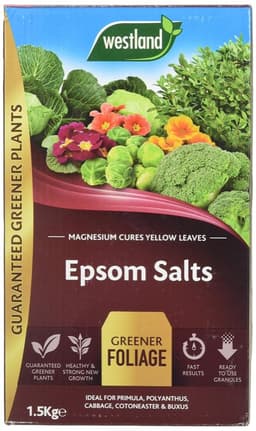
According to the manufacturer, Vitax’s sheet says 70 g per square metre as a base dressing, and 90 g in 4.5 litres as a liquid feed. Ninety grams in 4.5 litres is the same strength as 20 g per litre. The amazon row for Vitax B003MPGFIG prints 20g/l and does not print 70 g or 16.6% MgO. According to the manufacturer, Westland’s brand page says 20 g per square metre and 35 g in 4.5 litres. The amazon product data for B001P3SMQ0 does not print those grams. Its mixing field is 1:0:0. If the carton shows grams, follow the carton. If you only have 1:0:0, that is not a dose.

Dull days, gloves, and not the only feed

Spray on a dull day, or early or late, and do not spray in bright sun. The RHS warns that foliar feeds scorch leaves in strong light. One chilli review on the Vitax row mentions a white dusty residue after a spray. Dissolve the salts fully. This salt is not the only feed. The RHS lists Epsom salts as NPK 0–0–0 plus magnesium. Do not add washing-up liquid. Detergent in the spray is not an RHS step, and it is not on these listings.

Tablespoons and lawns

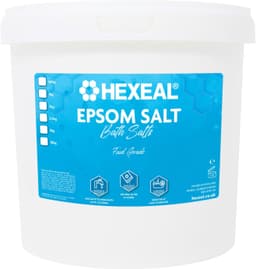
Hexeal’s garden bullet says 1–2 tablespoons in around 4.5 litres. A tablespoon is not 20 g unless you weigh it. The bath bullet of 250 g–1 kg is a bath, not a watering can. Westland’s brand page says they would not recommend these salts on a lawn. If the carton repeats that refusal, do not dress the lawn with it. Tomato watering and blossom end rot sit on Epsom salt fertiliser for tomatoes.

Common questions

Is 30 g per square metre the same as 20 g per litre?
No. Thirty grams per square metre is a soil dressing on light, free-draining soil in the RHS note. Twenty grams per litre is a foliar spray in summer. Vitax’s 90 g in 4.5 litres matches 20 g per litre. Vitax’s 70 g per square metre does not match the RHS soil figure. Use one job’s number, from the pack if it prints one.
Why does Vitax say 70 g per square metre?
That figure is on the Vitax label sheet, as a base dressing before sowing or planting. It is higher than the RHS 30 g per square metre for a deficiency on light soil. The amazon mixing field on the single carton is 20g/l, which lines up with 90 g in 4.5 litres, not with 70 g on the ground. If your carton prints 70 g per square metre, that is the soil rate for that carton.
What does Westland’s 20 g per square metre apply to?
On the Westland brand page it applies to trees, shrubs, flowers and vegetables, and as a top dressing, every 4–6 weeks from March to the end of August. The foliage mix on that page is 35 g in 4.5 litres. The amazon row does not print those grams. Its field is 1:0:0. Follow grams on the physical carton, not the 1:0:0 field.
Can I spray in sunshine?
No. The RHS says dull weather only, or the leaves scorch, with early morning or evening as the foliar window. Westland’s brand page also says not in bright sun and not when roots are dry. Wetting the leaves is the point of a foliar spray. Avoiding sun is the limit. Do not follow a “never wet the leaves” tip if you are making the RHS foliar mix.
Is one tablespoon the same as 20 g per litre?
Not unless you have weighed that spoon of that salt. Hexeal prints 1–2 tablespoons in around 4.5 litres. Twenty grams per litre in 4.5 litres is 90 g. A level tablespoon of a fine salt might be near that, and a heaped spoon of coarse crystals might not. Weigh it once. Do not assume the bath dose of 250 g–1 kg belongs in the can.
How often do I repeat a foliar spray?
The RHS says two or three times a fortnight in summer for the 20 g per litre spray. Westland’s brand page says every 4–6 weeks from March to the end of August for its own rates. Those are different calendars. Use the repeat on the pack you bought. If the pack has no repeat, the RHS fortnightly limit is the one to stop at, not a weekly top-up “to be sure”.
Can I use it as the only feed, or on the lawn?
It is not a complete feed. The RHS states Epsom salts as 0–0–0 plus magnesium. Keep your usual fertiliser for the other nutrients. Westland’s brand page does not recommend the salts on lawns and does not recommend bathing or eating them. A review that mentions greener grass does not overturn that line on a Westland carton. If your listing has no lawn sentence, it still has not given you a grams-per-square-metre lawn rate.

Related pages

Sources

Public UK sources from the research digest, used for this page in October 2026. Prices, stars and review counts are from the twelve amazon.co.uk listings captured on 19 October 2026. No listing here prints a magnesium oxide percentage. A shared review file is not two garden tests. This is not a laboratory test and not an RHS trial of these packs.

  1. RHS, Nutrient deficiencies (retrieved 19 October 2026)
  2. RHS, Fertilisers (retrieved 19 October 2026)
  3. RHS, Blossom end rot (retrieved 19 October 2026)
  4. GOV.UK, Manufacturing and marketing fertilisers (retrieved 19 October 2026)
  5. Regulation (EC) No 2003/2003 article 9 (retrieved 19 October 2026)
  6. Regulation (EC) No 889/2008 Annex I (retrieved 19 October 2026)
  7. Fertilisers Regulations 1991, Schedule 2 (retrieved 19 October 2026)
  8. Soil Association, organic salt clarification, 10 September 2024 (retrieved 19 October 2026)