Independent comparisons. We may earn from shop links. More info

How to install a garden fence

Updated: October 2026

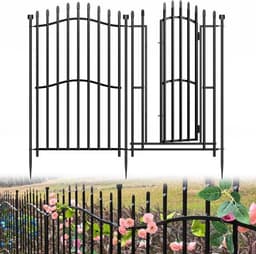
You have a no-dig panel kit, and the listing says you press the stakes in with no concrete. That holds only in soil that will take a thin pin. How to install a garden fence of this kind starts with a line, one test stake, and a stop if the pin bends. A metpost depth for a timber post does not transfer onto a hollow decorative pin. The product table is the [garden fence comparison](/hub/fencing-and-wire/garden-fence). A qualifying purchase can earn a commission at no extra cost to you.

You have a no-dig panel kit, and the listing says you press the stakes in with no concrete. That holds only in soil that will take a thin pin.

Our top picks

On this page

Set the line before you push anything in

Walk the run with a tape before the first pin goes in. A curved bed is longer along the soil than it looks across the lawn. Pull a string at the top of the panel, not at a 1.8 m line. If the run faces a road and the panel is over the usual 1 m cap in England, stop. Those checks are on the garden fence buying guide. Count the panels against the title. Koknows is the only pack that states both a stake count and a depth: 13 stakes, pressed about 23 cm, on the 76.2 cm fence. Other included lines say fence or Case. Check the bag, then push one stake at the first mark.

Join the panels the way the fitting allows

These borders do not share one clip. Thealyn panels use side rings. Other packs use a snap overlap or a hook-and-eye. The Koknows 102 cm listing names a rubber mallet. Follow the fitting in the box. Join two panels on the flat before the second stake. A slot on level ground will open on a curve. If the bed turns 90 degrees, start the return as its own line. If the first pin has leaned, fix that before you add length.

Slopes and a gate change the run

A slight slope is short steps, not one twisted panel. Keep each panel upright. If one end would have to be buried to keep the pin vertical, that spot is too steep. The gate goes where you need the opening. Reviews of the Koknows 102 cm gate and the tall Kingido gates call the leaf very narrow. Measure it before you set the panels either side. If the box does not contain the gate the title named, you do not have a bay to frame. If the test pin pulls out by hand, the run will rock.

Hard ground is the point you stop

If the test stake stays plumb, continue along the string. If the pin bends, stop. Koknows reviewers say the pins are hollow and bend in hard ground. A second blow folds them further. The same stop applies if a plastic lug snaps. Do not copy a metpost depth onto these kits. DIY Doctor’s concrete-in shoe is on the order of a 450 mm cube, and about 23 cm is the only stake depth in this set. If a cane will not enter, these kits will not either. Call a fencer when the boundary is disputed, the house is listed, or posts must go in concrete. If the soil failed, metal or wood garden fence is the next step.

Common questions

What do you do before the first stake goes in?
Tape the curve, set a string, and count the panels against the title, including any gate leaf. Check the 1 m road rule if the run faces a highway or its footpath. Close one joint on the flat, then press one stake and see if it stays plumb. Koknows states about 23 cm and 13 stakes on one pack. Other packs often do not count the pins, so count the bag yourself.
How do you join panels so a curve does not open a gap?
Use the clip in the box: side rings, a snap overlap, or a hook-and-eye. Close each joint before the next stake, and angle the joint on a curve instead of bending the panel. A slot on flat ground will open on a bend. A 90-degree corner is a new run. Extra length means another pack, which is what Koknows reviewers ordered when 7 m was not enough.
What if the first pin bends?
Stop. Hollow pins on the Koknows 76.2 cm pack bend in hard ground, and a second blow folds them further. The same stop applies if a plastic lug snaps. Do not switch to a metpost mallet and a 450 mm concrete shoe and pretend it is the same kit. If one pin will not stand, the soil wants posts, not a longer run of the same stake.
How do you cross a slight slope?
Keep each panel upright and let the joint take a small step in height. A bullet that says panels adjust to uneven ground is a claim, not a measured fall. If one end would have to be buried to keep the pin vertical, that spot is too steep. Do not twist a welded panel to follow the lawn. A twisted panel pulls the stakes you have just set.
Do you need concrete for these kits?
No, if the test stake holds. The listings sell a no-dig press-in fit, and concrete is a different fence. DIY Doctor’s concrete-in shoe is roughly a 450 mm cube for a post spike, which these pins are not. If the pin bends or the panel rocks, concrete under a thin stake is not the repair. Posts set properly are the repair when the boundary has to stay.
Where does the gate sit in the run?
Where you need the opening, after you have measured the leaf. Reviews call the Koknows 102 cm gate and the tall Kingido gates very narrow. Set the panels either side of that bay so the leaf meets both sides. If the box does not contain the gate the title named, you do not have a bay to frame. A leftover panel is a poor reason to put the opening at the end of a curve.

Related pages

Sources

Public UK sources and the amazon.co.uk listings used for this comparison. Prices stored 19 October 2026.

  1. Town and Country Planning (General Permitted Development) (England) Order 2015, Class A (retrieved 19 October 2026)
  2. Planning Portal, fences, gates and garden walls: planning permission (retrieved 19 October 2026)
  3. Planning Portal, fences, gates and garden walls: building regulations (retrieved 19 October 2026)
  4. Scottish Government, circular 1/2024, Class 3E (retrieved 19 October 2026)
  5. Planning (General Permitted Development) Order (Northern Ireland) 2015, Part 3 Class A (retrieved 19 October 2026)
  6. Welsh Government, planning permission for fences, gates and garden walls (retrieved 19 October 2026)
  7. GOV.UK, Party Wall etc. Act 1996 explanatory booklet (retrieved 19 October 2026)
  8. BSI, BS 1722-11 prefabricated wood panel fences (retrieved 19 October 2026)
  9. Consumer Rights Act 2015, section 9 (retrieved 19 October 2026)