Independent comparisons. We may earn from shop links. More info

Fix a leaning fence post

Updated: October 2026

The panel has started to lean, and the rot is usually at the base. Fix a leaning fence post with a repair stake only if the timber will hold screws and the blade can pass the old footing. If either fails, replace the post. The stakes are on the [fence post spike comparison](/hub/fencing-and-wire/fence-post-spike). Peter F. used those amazon.co.uk listings and public UK guides on 19 October 2026. A qualifying purchase can earn a commission at no extra cost to you.

The panel has started to lean, and the rot is usually at the base. Fix a leaning fence post with a repair stake only if the timber will hold screws and the blade can pass the old footing.

Our top picks

On this page

Test the post before you buy a stake

Push the post at about chest height. A small movement that stops when you let go is a lean you might brace. A post that keeps travelling is telling you the base has gone. Prod the timber where the screws would go. Sound wood resists a screwdriver. Soft, dark, or crumbling wood does not. One trade note uses about 300 mm of soft timber above the ground as a prompt to replace. That line is a rule of thumb, not a British Standard. A stake cannot make soft wood hold a screw. If several posts lean the same way, look at the end post first. If the panels are already on the ground, you are past a brace. A shared boundary is a conversation before it is a hammer.

A side stake when the wood is sound

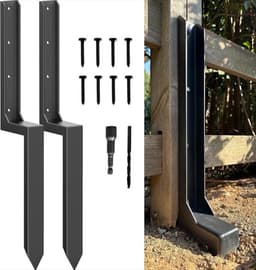
When the push test passes, drive a side stake beside the post and screw it into sound wood. Pre-drill so the post does not split. Use your own drill bit if the included one snaps. arksoldier is about £47.52, 4.6 from 759 reviews. IRONBABE is about £47.59, 4.6 from 511. Both are one-piece braces for 4x4 and 6x6, not sockets. How a socket differs is fence post spike vs repair spike. The blade still has to pass the footing. A crank can miss a narrow collar, and a review also says the point hits the concrete. Forcing a thin stake is the buckle already in cheaper files, from about £19.99. If the blade meets concrete, you stop.

Snapped off in concrete, or already fallen

A post snapped off at the ground, with the stump still in sound concrete, is not a long side stake. The trade piece is a short repair socket between the wood and the footing. Screwfix lists a Sabrefix 75 mm repair two-pack at £21.95 including VAT on 19 October 2026 for that break. This set is mostly long side stakes. If the collar is too wide, breaking the footing out can become a full reset. If the run has already fallen, reset the posts in concrete. A concrete spur, bolted only into sound timber, is the alternative when the collar blocks every metal spike.

When the repair is the wrong saving

A gate post, a windy corner, a row with no sound timber, and a boundary you do not own are the wrong saving. A cable you cannot rule out is a stop as well. The locate is on how to install a fence post spike, because this repair still drives steel into the ground. In England, Planning Portal guidance lets you maintain a fence if you do not raise it above its former height or above the Class A limits: 1 metre next to a highway used by vehicles, and 2 metres elsewhere. Listed buildings sit outside that. Scotland, Wales, and Northern Ireland have their own orders.

Common questions

Can I straighten a leaning post with a repair stake?
Yes, when one panel leans, the timber is solid where the screws go, and the soil beside the post will take a blade. You drive the stake, screw it to the sound face, and rehang the panel. You cannot do it if the wood is soft, or if the blade hits the old concrete. A fallen run is a reset, not a brace.
How do I tell sound timber from rot?
Push the post, then prod the bolt line with a screwdriver. Sound wood is firm. Soft, dark, or crumbling wood will not hold a screw. One trade guide treats softness more than about 300 mm above the ground as a reason to replace. That figure is a rule of thumb, not a British Standard. If the bolt line is soft, do not buy the stake.
What if the stake hits the old concrete?
Stop. A crank sometimes misses a narrow collar, and reviews also describe the point striking the footing. Hitting harder bends thinner stakes and can split a weld. A wide collar may need the footing broken out, which DIY Doctor notes can become a full reset. It is not a reason to switch to a cheaper blade and try again.
The post has snapped off at the ground. Is a long stake the right part?
No. A post broken off in sound concrete wants a short repair socket, such as the Screwfix Sabrefix 75 mm repair two-pack at £21.95 including VAT on 19 October 2026. The long stakes in this set screw to the side of a post that is still standing. They do not sleeve a stump inside the footing.
Do I need planning permission to repair a fence in England?
Like-for-like repair that does not make the fence taller than it was, and that stays within 1 metre by a vehicular highway or 2 metres elsewhere, is the Class A position Planning Portal describes. Listed buildings and Article 4 directions are outside that. Scotland, Wales, and Northern Ireland use their own rules. Raising the fence is a different question from bracing a post.

Related pages

Sources

Public UK sources listed in the research digest. Listing prices, stars and review counts are from the amazon.co.uk captures for these ASINs. Screwfix prices are the figures dated 19 October 2026 in that digest.

  1. England Class A limits for gates, fences and walls (retrieved 19 October 2026)
  2. Timber fencing sheet — post depth, spikes and concreting (retrieved 19 October 2026)
  3. HSE HSG47 — avoiding danger from underground services (retrieved 19 October 2026)
  4. LSBUD — utility plans from member companies (retrieved 19 October 2026)
  5. Screwfix Sabrefix 75 mm drive-in spikes, 2 pack (retrieved 19 October 2026)
  6. Screwfix Sabrefix 75 mm repair spikes, 2 pack (retrieved 19 October 2026)
  7. East Coast Fencing — spikes, shoes and repair supports (retrieved 19 October 2026)
  8. Consumer Rights Act 2015 (retrieved 19 October 2026)