Independent comparisons. We may earn from shop links. More info

How to connect a solar cable

Updated: October 2026

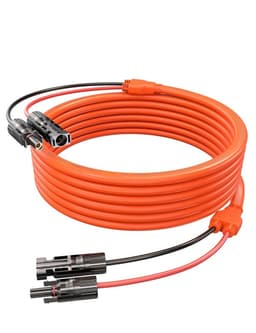
You have a pre-terminated red and black pair and a panel on the ground, and the plastic housings do not look like the diagram you expected. How to connect a solar cable, for that job, is a polarity check with the panel covered, then a click you can hear, then a stop. Male and female describe the metal contact, not the shape of the shell, and a DC string in daylight is already live. It is not a product ranking and not a lab test. The leads are on the [solar cable comparison](/hub/electrical-equipment/solar-cable).

You have a pre-terminated red and black pair and a panel on the ground, and the plastic housings do not look like the diagram you expected.

Our top picks

On this page

Cover the panel before you touch the plugs

Daylight on a photovoltaic module produces a DC voltage whether or not you have finished the plugs. Cover the face, or isolate the string, before you hold the contacts. BEAMA says isolate, prove that current is zero, then use the unlock tool, one conductor at a time. A locked MC4-type shell is not a switch. A lead you can break every evening is a different connector, on MC4 or SAE solar cable. A printed plus can be on the wrong end. The named pairs are on best solar cable, and the name does not change the order.

Follow the conductor, not the plastic shape

The metal pin is the male contact. The metal socket is the female contact. The plastic housing around them is often the other way around. Do not decide polarity by which shell looks male. Mate positive to positive and negative to negative. One iGreely buyer said the positive plug was on the negative cable. Another said that layout is how many panels are built. Meter the conductor, with the panel covered. A click is not a brand match. BEAMA and Stäubli both say photovoltaic connectors should be from the same manufacturer and the same family. MC4 is Stäubli’s trademark. Two housings that click can still be a cross-mate.

Click, then stop

With the panel covered, mate one polarity. Push the housings until they lock, then tug the connector body, not the wire. Then mate the other polarity the same way. Only then do you uncover the panel or close the isolator. Unplugging is the same discipline in reverse. Isolate, prove zero current, then use the dedicated unlock tool. Do not lever the shell with pliers. Stäubli’s data table for their MC4 states a maximum on the order of 100 mating cycles. Those figures are not a measurement of the Chedin, iGreely or Tonton copies in this set. MIS 3002 asks for the maker’s tools, a drip loop, and connectors that are not left in standing water.

When the lead is not actually pre-terminated

iGreely’s bullet says the connectors are fitted. One UK review said the MC4-type plugs still had to be crimped on. If your parcel matches the review, you own cable and loose contacts. Pliers are not the connector maker’s tool. LukAro is 3 m of black 6 mm² with no connector, and borrowing a random housing is how cross-mating starts. A roof penetration or a string voltage you cannot account for is no longer a plug-in job. In England, Approved Document P puts roof photovoltaic work on a dwelling inside electrical safety. The checks before the parcel are on the solar cable buying guide.

Common questions

Do I need a tool to unplug an MC4-type connector?
Yes. These connectors lock, and the proper release is the maker’s unlock tool, after the string is isolated and you have proved that current is zero. Do not pull the wire, and do not lever the housing with pliers. Mating can be a straight push until the click. Unmating is not the reverse of a tug. A shell that will not release is a reason to stop, not a reason to cut the lead.
Can I unplug it while the panel is in the sun?
No. A module in daylight is a live DC source, and breaking the connector under load arcs at the contacts. Cover the panel or open a proper isolator, and prove zero current, before you separate the housings. That applies to one panel on a stand as well as to a roof string. Stäubli’s cycle figure for their own connector is not permission to do this daily, and it was not measured on the copies in this set.
What if the two brands click together?
A click is not approval to leave them mated. BEAMA and Stäubli say DC photovoltaic connectors should be the same manufacturer and the same family. MC4 is Stäubli’s name, and “compatible” in a title is not their authorisation. Separate a cross-mate only once the string is isolated. If the panel tails and the extension are different systems, replace one of them rather than running the joint.
The seller says no tools. A review says I still need a crimp. Who is right?
Both lines can be true of different parcels, and you have to look at yours. iGreely’s bullet says the connectors are fitted. One UK review said they still needed crimping. If the contacts are loose, do not improvise with pliers. Return the lead or use the connector maker’s crimp tool. This page does not include a crimp tutorial, because a wrong die is how the joint heats up later.
At what point do I stop and get an electrician?
Stop when the array is fixed to a dwelling, when you cannot account for the string voltage, when a connector is hot or browned, or when the work includes a consumer unit or a grid notification. A loose crimp, a cross-mate, or a joint sitting in water is the same stop if you cannot remake it with the right tool and the right connector family. A portable panel you can cover and unplug is the job this sequence is for. A roof is not.

Related pages

Sources

Public UK sources are listed below. Shelf prices and star lines are the amazon.co.uk figures checked on 21 October 2026.

  1. Tratos, BS EN 50618 (retrieved 21 October 2026)
  2. BASEC, solar photovoltaic cables (retrieved 21 October 2026)
  3. Prysmian PRYSUN datasheet (retrieved 21 October 2026)
  4. MCS installation guide (retrieved 21 October 2026)
  5. MIS 3002, solar PV systems (retrieved 21 October 2026)
  6. BEAMA technical bulletin, DC PV connectors (retrieved 21 October 2026)
  7. Stäubli, cross-mating of PV connectors (retrieved 21 October 2026)
  8. Approved Document P (2013) (retrieved 21 October 2026)