Steam generator vs steam iron: when the base is worth it

Decide steam generator vs steam iron by the pile. A station suits a family wash if you can store the base; a few shirts a week still suit an ordinary iron.
On this page

Steam generator vs steam iron is the decision to make before you compare models. Two school shirts and a pair of work trousers are done, and the double duvet cover is still on the airer. The iron in the cupboard keeps a small tank in the handle. Halfway through the duvet the steam thins. A station, with the water in a base and a hose up to the soleplate, looks like the way to finish that pile in one fill.
That station is the right tool only when the pile is large enough to justify the box. Products Compared scored steam-generator listings on amazon.co.uk in October 2026 and read public guides from Which?, Expert Reviews and John Lewis. We did not run a lab test. A qualifying purchase through our links can earn us a commission at no extra cost to you. Which? points pressurised generators at large loads and describes them as dearer, bulkier and noisier. Expert Reviews puts bed linen and a large pile on the generator side, and lightly creased clothes on the ordinary-iron side.
In short
Buy a steam generator when you regularly iron a family wash, including shirts and bed linen, and you can store a base of roughly 3–6 kg at waist height or on the floor. Keep an ordinary steam iron if you only press a few shirts a week, or if the cupboard cannot take that base. A garment steamer is a third tool: it has no soleplate, so it will not press a crease into trousers.
Buy the base for the pile, not the odd shirt
Start with last week's wash, not with the largest number on the box. John Lewis describes a generator as a lighter hand unit on a bulky base, aimed at about two laundry baskets: shirts, school clothes, tea towels and bedding. One shirt before work is a different job. If the odd shirt is your whole week, you do not need a steam generator for shirts.
The usual mistake is buying the base because one duvet defeated a small tank, then finding the station on the kitchen floor. Expert Reviews says store the base low or at about waist height, on its own shelf or a board with a holder. A shelf you need a chair to reach is a poor home for roughly 3–6 kg. Without that place, keep the ordinary steam iron.
The opposite mistake is staying with the small tank when bedding is in the pile every week. Which? says generators produce more steam and need fewer refills, and that pressurised models suit large loads. Family listings in this comparison cluster around a 1.7–1.8 litre tank and continuous steam from about 120 g/min. Which? and Expert Reviews both treat the generator as the dearer type. A higher price is not a higher rating score.
What moves out of the handle
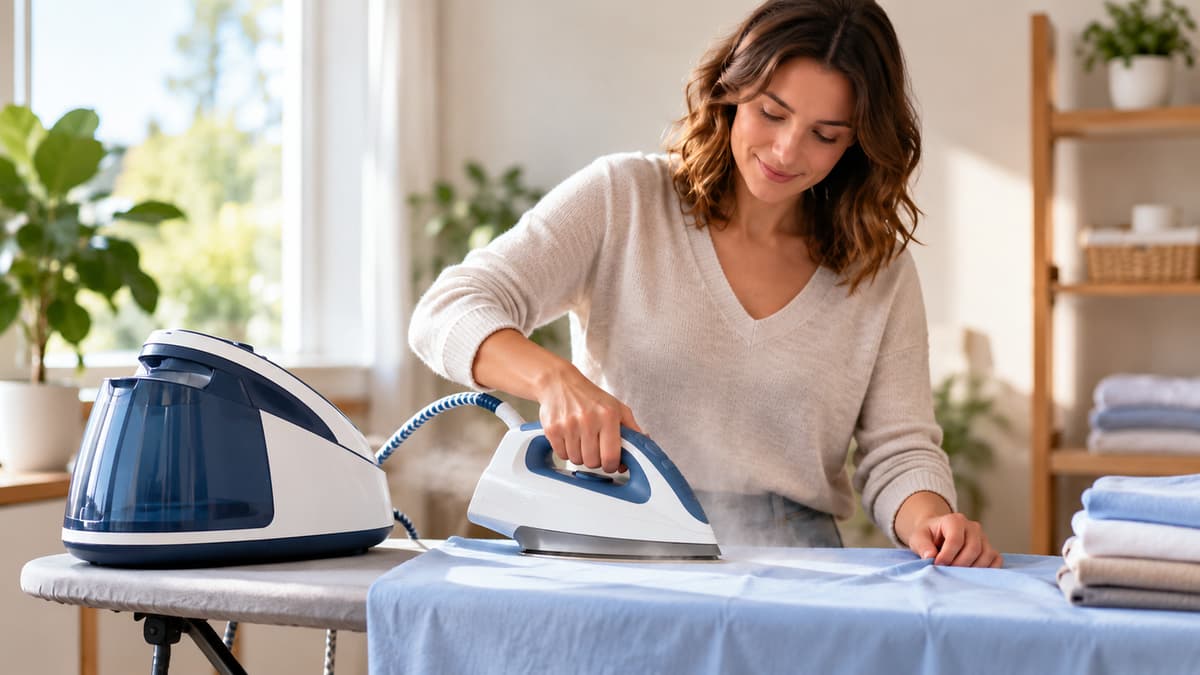
An ordinary steam iron is one object. The tank, the soleplate and the controls travel together. A steam station splits that object. The water sits in the base, and the piece you hold is a soleplate and a handle on a hose. Expert Reviews says the hand unit is lighter because the tank has left it. The kilogram figure on the product page is the whole station, not what your wrist feels across a sheet.
The hose has to reach the far end of the board without you dragging the base along the carpet. Stand the base beside the board so the mains lead and the hose are not one tangle. The base still needs floor space or a low shelf. If you pack the board away after every shirt, you lift the base every time. That lifting is the bulky half of steam station vs steam iron.
You still press with a hot soleplate, matched to the fabric label. On two Philips listings, OptimalTEMP is described as not burning ironable fabric if the iron is left unattended. That wording is not a promise that every station is safe on silk. Read the Tefal Pro Express Protect GV9230 instructions, then press.
Steam, refills, noise and heat-up
Which? says generators produce more steam and need fewer refills. A family-sized station here tends to show continuous steam from about 120 g/min and a tank around 1.7–1.8 litres. A boost shot, a bar number and grams per minute are different labels. The useful test is whether you run out of water before the pile is finished.
A small tank means a walk to the tap in the middle of a duvet cover. Expert Reviews describes the generator case as a large pile that justifies one fill. If your iron already finishes a week's shirts on one fill, you will feel the wait, not a change in the water. Heat-up is up to about three minutes on some models: a small slice of a bedding session, and a poor trade for one shirt.
The pump in the base is what people mean by a steam generator noisy enough to matter in a flat. Which? and Expert Reviews both call generators noisier than a normal steam iron. We did not measure decibels. If someone is asleep next door, or you are on a call, the ordinary iron is the quieter tool.
Expert Reviews has written that a generator can cut ironing time by up to a third. That is their claim, not a measurement from this comparison. Vertical steam counts only where the amazon.co.uk listing states it, and it is still a press with a soleplate.
The weight you lift is not the listing weight
A product page prints one weight. You lift the hand unit on every pass, and the base when you fetch it and put it away. The hand unit should feel lighter, because the water is no longer in the handle. If a listing gives only the total, keep that total for the cupboard and the stairs.
Can you carry the base to the board in one trip? If the board is upstairs and the only space is downstairs, a tired Thursday ends with the old iron. Store it low, or at about waist height, not on a shelf you need a chair to reach. Steam generator or steam iron for a family depends on whether that base stays parked for the whole session.
A garment steamer is a different product
Search results mix three tools. An ordinary steam iron presses with a hot soleplate and a small tank. A steam station presses with a soleplate fed from a base. A garment steamer has no soleplate. Expert Reviews notes that a steamer does not press a sharp crease the way a soleplate does. John Lewis lists handheld steamers as their own type, not in the generator row.
If trousers need a crease, a steamer is the wrong buy. If you only want to relax a blouse on a hanger, a steamer can be enough, and a station of roughly 3–6 kg is more machine than that job asks for. Garment steamer vs steam iron is a different comparison. This page does not choose a steamer for you.
Which page to open next
If the pile is large and the cupboard can take the base, open the steam generator comparison. It scores amazon.co.uk listings, with prices in GBP. The highest rating score in that set is 90, and more than one station reaches it. The top pick in the box is the Tefal Pro Express Protect GV9230, ASIN B08XXYC9L8, at about £199. You can open that listing on amazon.co.uk. A high score in this set is not a claim that any iron is the best in Britain, and not a promise about silk.
The steam generator vs steam iron page sets heat-up, noise, storage, and who should stay with a normal iron. The buying guide covers tank size and soleplate once you have decided you want the base. Settling the pile first keeps a bar number from making the decision.
If you are still unsure, count one ordinary week: the garments, the walks to the tap, and the floor beside the board. One shirt and no spare shelf means you keep the iron you have. Two baskets and a space at waist height is the job those guides describe.
Common questions
Is a steam generator better than a steam iron?
I only iron a few shirts. Do I need the base?
Will the iron in my hand be lighter?
Are steam stations noisy?
How long do they take to heat?
Is a garment steamer the same thing?
What tank size suits a family wash?
Where do I compare the actual stations?

Products Compared publishes British-English buying guides based on amazon.co.uk listings and public UK sources. We do not run a lab and we do not invent test scores.
Related articles

The UK plug and fuse on a steam generator
Fit a 13 A BS 1362 fuse in a BS 1363 plug. A 3 A lamp fuse or a travel adaptor is the wrong spare.

Continuous steam, boost and bar
Grams per minute, a boost shot and a bar rating are not one scale. Read them only after you know you want a station.
What a steam generator iron costs in the UK
Shelf prices elsewhere are not this comparison's amazon.co.uk bands. Check the GBP figures before you clear cupboard space.