How to use an automatic wire stripper
You already own a self-adjusting wire stripper, the cable in front of you should be dead, and the first squeeze can still nick the copper. An automatic jaw follows the outside of the insulation. It does not know the terminal you are about to use, and it does not forgive a blade set too deep. This page is how to use an automatic wire stripper on that proved-dead conductor: length stop first, pressure light, one full squeeze, then a look all round the copper. It is written against the pliers in the [automatic wire stripper comparison](/hub/electrical-equipment/automatic-wire-stripper). A qualifying amazon.co.uk purchase from the main table can earn a commission at no extra cost to you.
You already own a self-adjusting wire stripper, the cable in front of you should be dead, and the first squeeze can still nick the copper. An automatic jaw follows the outside of the insulation.
You already own a self-adjusting wire stripper, the cable in front of you should be dead, and the first squeeze can still nick the copper. An automatic jaw follows the outside of the insulation. It does not know the terminal you are about to use, and it does not forgive a blade set too deep. This page is how to use an automatic wire stripper on that proved-dead conductor: length stop first, pressure light, one full squeeze, then a look all round the copper. It is written against the pliers in the automatic wire stripper comparison. A qualifying amazon.co.uk purchase from the main table can earn a commission at no extra cost to you.
Our top picks
| Badge | Product | Length stop | Pressure | Jaw or feed | Note | Price | Offer |
|---|---|---|---|---|---|---|---|
| Best overall |  STANLEY FATMAX Stanley FATMAX FMHT0-96230 | Adjustable wire stop | Fine adjustment screw | Automatic jaws; entry not stated | 8.7 | about £21.61 | View offer |
| Best value |  VCELINK VCELINK GJ702 | Length slider | Rear pressure knob | Eagle nose | 8.6 | about £8.99 | View offer |
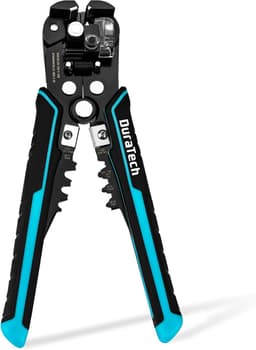
 DURATECH DURATECH DT211010A | Length adjustment stop | Tension knob | Self-adjusting jaws | 6.9 | about £17.99 | View offer |


On this page
Prove the cable is dead
Set the length stop
Set the pressure and strip once
Inspect and cut off a nick
Common questions
Do I turn a dial to the mm² size?
What do I set first, the length stop or the pressure?
Which way does the pressure knob go?
How hard should I squeeze?
What do I do if the insulation slips or the copper is nicked?
Does the same squeeze strip a sheath and a single core?
Related pages
Sources
Public UK sources from the research digest. Shelf prices and star lines are the amazon.co.uk figures captured on 19 October 2026.
- HSE HSR25, Electricity at Work Regulations 1989 guidance (retrieved 19 October 2026)
- Professional Electrician, insulated hand tools (retrieved 19 October 2026)
- Maun Industries, VDE and insulated tools (retrieved 19 October 2026)
- Clean Air Act 1993, section 33 (retrieved 19 October 2026)
- Environment Agency, illegally burning waste (retrieved 19 October 2026)
- IET Part P FAQ (retrieved 19 October 2026)
- GOV.UK, when building regulations approval is not needed (retrieved 19 October 2026)
- H&S Metals, stripping copper wire for scrap (retrieved 19 October 2026)