Independent comparisons. We may earn from shop links. More info

Aerial splitter vs amplifier

Updated: October 2026

You are about to buy a booster because it sounds safer than a plain splitter, even though the living-room television is already fine. A booster is the wrong first part for that room. A splitter divides the level and adds no noise. An amplifier is powered, adds noise, and earns its place when the signal is weak or you have many outlets. This page does not rank the eleven listings in the [aerial splitter comparison](/hub/electrical-equipment/aerial-splitter). None of them is an amplifier. A qualifying amazon.co.uk purchase can earn a commission at no extra cost to you. Add gain only when the split itself causes the break-up.

You are about to buy a booster because it sounds safer than a plain splitter, even though the living-room television is already fine. A booster is the wrong first part for that room.

Our top picks

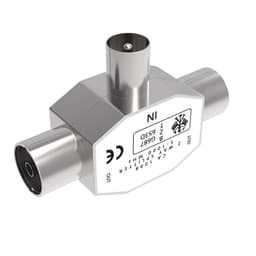
Ancable Ancable T splitter

Best overall

Ancable Ancable T splitter
9.0/10about £5.99
AXFEE AXFEE 8-piece kit

Best value

AXFEE AXFEE 8-piece kit
9.0/10about £4.79
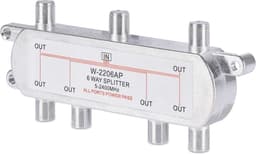
SSL SSL 6-way

Rank 3

SSL SSL 6-way
8.8/10about £7.99
On this page

What each device does to the signal

A passive splitter is a junction. One aerial lead goes in and each output receives less of the same signal. A two-way is about 4 dB of loss. It adds no hiss. An amplifier raises the level and the noise floor with it, so use one only as a last resort. A booster will not repair a broken lead or an aerial aimed at the wrong transmitter. Empty sockets on a splitter still count. For two sets in one room, the splitter is the first buy. That job is on split one aerial to two TVs. A distribution amplifier comes after a fair two-way has made the second set break up while a direct lead to the first set is still clean. Fitting a booster first, near a strong transmitter, often makes the picture worse.

Masthead, set-back and distribution

A powered amplifier can sit in three places. A masthead is up at the aerial, before the downlead loses level, and it is usually fed by DC sent up the coax. A set-back amplifier sits indoors and lifts whatever arrives, noise included. It cannot repair an aerial that is receiving nothing useful. A distribution amplifier sits where the cables split, often in the loft, and feeds several rooms. That is the box you move to once you leave a simple two-way.
Ancable Ancable T splitter

Testsieger

Ancable Ancable T splitter
9.0/10about £5.99

Power pass on these listings

The masthead only runs if something sends DC up the cable, and the splitter in that cable has to let the DC through. Only the SSL 6-way, B077FBT9SR, states that all ports are DC power pass. It does not print a pass voltage. One review wanted 9 V and said the unit did not do what that buyer needed. The Ancable lists a 12 V DC maximum. The AXFEE kit and the RUNCCI-YUN list a 5 V maximum. None of those three says power pass. Do not buy the six-way merely to keep a masthead alive for two sets. The plug sequence, once the part allows it, is on how to fit a TV aerial splitter.

Too much signal, and when to stop

Too much signal looks like too little: break-up, missing channels, a picture that comes and goes. The remedy is an attenuator, not another booster. Homes close to a main transmitter are the usual place. If the picture improves when you unplug an old loft amplifier, you have the answer. A faulty or waterlogged masthead can affect neighbours, so treat roof work as an installer's job. Call one when a loft distribution amplifier needs a new mains point, or when one passive split and one careful amplifier still leave the tuners short. The Confederation of Aerial Industries' find-an-installer route is the list people use.

Common questions

Will a booster give a sharper picture than a splitter?
Not if the first television is already clean. A booster raises level and noise together. A splitter only divides level. On a short, strong lead a booster can overload the tuner and make the picture worse.
Two televisions in one room: splitter or distribution amp?
A passive two-way, if each set already works on a short lead from the same socket. A distribution amplifier is for the case where that split makes one set break up, or where you are feeding several rooms from the loft. Buying the amplifier first skips the test that would have told you the splitter was enough.
What is a masthead amplifier?
It is a powered amplifier fitted at the aerial, before the downlead, used when the rooftop signal is weak. It needs a power supply, often DC sent up the coax. It is not a Y-piece, and a living-room splitter will only sit in front of it if that splitter actually passes the DC. Most rows in this set do not say they do.
What is a set-back amplifier?
It is a powered amplifier near the television, lifting the signal that has already travelled down the cable. It can help one low outlet. It also amplifies noise and interference that the cable has picked up. It is the wrong tool for two strong sets in the same room, and it will not fix an aerial pointed the wrong way.
If I already have a masthead, will any splitter in this set power it?
No. Only the SSL six-way states DC power pass, and it does not print the voltage. The Ancable's 12 V maximum and the 5 V maximum on the AXFEE kit and the RUNCCI-YUN are not power-pass claims. Do not buy the six-way merely to keep a masthead alive for two sets.
The picture breaks up near the transmitter. Is that too weak?
Often it is too strong. A powerful local transmitter can overload a tuner, especially if an old amplifier is still in the loft. Too much level points to an attenuator. Adding another booster is the step that makes overload worse.
Who fits a loft distribution amplifier?
An aerial installer, once you are past a single passive two-way and the work needs a mains supply, a masthead or a new cable run. Use a CAI member rather than a name from a product listing. If you are a tenant on a communal system, the landlord authorises a change.

Related pages

Sources

Public UK sources from the research digest, last checked on 19 October 2026. Shelf prices and star lines are the amazon.co.uk figures checked on 19 October 2026.

  1. A.T.V. Poles: aerial splitters (retrieved 19 October 2026)
  2. BBC Reception: how to choose the right amplifier (retrieved 19 October 2026)
  3. BBC Reception: what is a good Freeview installation (retrieved 19 October 2026)
  4. BBC Reception: troubleshooting Freeview reception (retrieved 19 October 2026)
  5. BSI: BS EN 60728 series (retrieved 19 October 2026)
  6. CAI: single-dwelling installation code of practice (2022) (retrieved 19 October 2026)
  7. GOV.UK: Radio Equipment Regulations 2017 (retrieved 19 October 2026)
  8. Sandwich Electrical: fitting a UK TV aerial coaxial connector (retrieved 19 October 2026)