Independent comparisons. We may earn from shop links. More info

Universal drill bit for brick

Updated: October 2026

You are fixing a rail to a UK wall that might be solid brick, hollow brick, or tile over brick, and you would rather use one bit than an SDS kit. A universal drill bit for brick can make that hole when the tip is carbide and the diameter matches the plug. It will not, if the box is high-speed steel, and it will not do tile and brick on one hammer setting. Prices sit on the [universal drill bit comparison](/hub/drilling-and-accessories/universal-drill-bit). This page is the wall, the plug and the glaze, not a ranking of every HSS set.

You are fixing a rail to a UK wall that might be solid brick, hollow brick, or tile over brick, and you would rather use one bit than an SDS kit.

Our top picks

fischer fischer D-U Hex 6 mm

Best overall

fischer fischer D-U Hex 6 mm
9.0/10about £3.48
On this page

What the wall is made of

Name the wall before you name the mode. Solid brick, perforated brick, block and a tiled face are not one switch position. ManoMano’s UK guide treats solid brick as a hammer job and hollow brick as a job that often stays off hammer, because the webs break if you pound them. A tiled bathroom wall is often a thin glaze over whichever of those is behind it. Glaze and brick are two operations. Hammer from the first second cracks the glaze. Hammer off for the whole depth can polish brick or break a hollow web.

The hole the plug actually needs

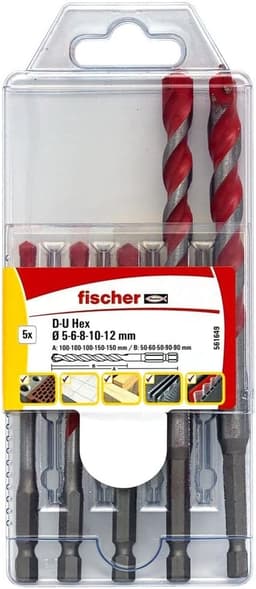
Diameter and depth are different promises. fischer’s DuoPower 6 x 30 takes a 6 mm drill, a minimum hole depth of 40 mm, and screws of about 4–5 mm. The kilogram loads on that page are the maker’s figures, not a promise for your wall. Forty millimetres is the worked example for that 30 mm plug, and the packet beats a remembered rule. Screwfix’s common red plug is 6 mm as well. A 7 mm brown plug is a different diameter. The fischer set here is 5, 6, 8, 10 and 12 mm. Seven millimetres is not in it. The single 6 mm bit matches a 6 mm plug and nothing else. The drilling sequence is on how to use a universal drill bit.
fischer fischer D-U Hex 6 mm

Testsieger

fischer fischer D-U Hex 6 mm
9.0/10about £3.48

Tile first, then the wall

If brick sits behind a tile, drill the glaze with hammer off. Homebuilding, Topps Tiles and ManoMano all keep hammer off the tile. Once you are through the tile, change to a bit for the wall behind. A brick-and-tile claim does not mean one mode through both layers. Wickes’ page for the Bosch HEX-9 set says impact for concrete and stone, and rotary for brick, soft ceramic, sheet metal, wood and plastic. That split belongs to that Bosch set. It is not printed on the fischer D-U Hex listing, which says rotary and impact. HEX-9 is not an ASIN in our table. It is a published example of mode changing with the material. Porcelain that only dents is the moment for a diamond bit.

Which kept bits belong on this wall

The carbide rows are the ones for this wall. The fischer D-U Hex listings name brick and tile. The set still has no 7 mm. toolant claims brick, tile and concrete, with a hammer-drill title that reviews do not all follow. It is not a second fischer bit. Bosch mixed cases hold separate masonry bits and are not re-ranked here. In a pre-2000 home, do not drill boards you suspect may contain asbestos. Written by the Products Compared editorial team, updated 15 October 2026, from amazon.co.uk listings and public UK fixing and tile guides. No lab test. A qualifying purchase through our links can earn us a commission at no extra cost to you.

Common questions

Do you use hammer on brick and on tile?
Not as one setting. Hammer stays off on the glaze, which is the Homebuilding, Topps and ManoMano line. For the wall behind, Wickes’ HEX-9 text says impact for concrete and stone, and rotary for brick and soft ceramic. The fischer D-U Hex listing says rotary and impact, and that is not the Wickes line. Follow the bit in the chuck. Hollow brick is often drilled without hammer so the webs survive.
What hole does a 6 mm DuoPower need?
fischer’s DuoPower 6 x 30 page specifies a 6 mm drill and at least 40 mm of depth, with screws of about 4–5 mm. The 6 mm bit is the right diameter and the wrong depth if you stop at the end of the plastic. Loads on that page differ by substrate and are the maker’s figures, not a guarantee for your brick. A 7 mm brown plug is a different hole, and it is not in the 5–12 mm set.
What do you do when the tile is only the face?
Drill the tile with hammer off, slowly, then change to a bit for the brick or block behind. Topps Tiles and Homebuilding both describe that change. Ceramic can be a carbide tile bit. Porcelain is where those guides send you to diamond. A multi-material bit that lists tile is not permission to stay on hammer, or on the same bit, once the glaze is through.
Is porcelain the same job as ceramic?
No. Ceramic is the job a carbide spear, or a careful carbide multi-material bit, is often asked to start, with hammer off. Porcelain is denser, and Topps and Homebuilding point to diamond. If a universal bit only polishes a white spot, stop. Forcing it chips the glaze or overheats the tip. Treat porcelain as a different tool, not as slower ceramic.
When is a combi enough, and when do you want SDS?
A combi is enough for a short run of plug holes in ordinary brick with a carbide bit that fits the chuck. You want SDS for heavy concrete, a long session, or a shank your combi cannot lock. A hex universal bit does not become an SDS bit because a category label says so. If the hole has outgrown a plug, you need a different drill.

Related pages

Sources

Public UK sources and the amazon.co.uk listings for these ten ASINs. Retrieved 16 October 2026.

  1. fischer UK, universal drill bit D-U Hex (retrieved 16 October 2026)
  2. Bosch DIY, guide to drills (retrieved 16 October 2026)
  3. B&Q, how to choose the right drill bits (retrieved 16 October 2026)
  4. Screwfix, guide to types of drill bits (retrieved 16 October 2026)
  5. ITS, types of drill bit explained (retrieved 16 October 2026)
  6. HSE, CN3 construction dust and silica (retrieved 16 October 2026)
  7. GOV.UK, asbestos in buildings (retrieved 16 October 2026)
  8. Electrical Safety First, DIY and cables (retrieved 16 October 2026)