Independent comparisons. We may earn from shop links. More info

Pillar drill for metal

Updated: 2026-10-23

You are about to drill mild steel, and the metal column on the listing looks like a promise. A pillar drill for metal is not the machine with the largest number in that cell. In this amazon.co.uk capture, only one maker states a hole size in steel. The other metal cells copy a chuck size, a depth, or a claim. This page is that limit in October 2026. The [pillar drill comparison](/hub/drilling-and-accessories/pillar-drill) holds the eight prices. We did not cut a test coupon. A qualifying purchase can earn a commission at no extra cost to you.

You are about to drill mild steel, and the metal column on the listing looks like a promise. A pillar drill for metal is not the machine with the largest number in that cell.

Our top picks

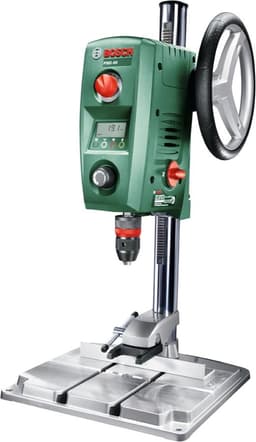
Bosch Bosch PBD 40

Best overall

Bosch Bosch PBD 40
9.2/10about £279.94
Einhell Einhell TC-BD 450

Best value

Einhell Einhell TC-BD 450
8.8/10about £123.93
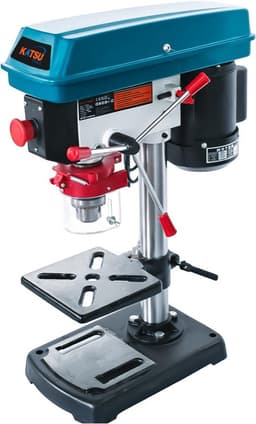
KATSU Tools KATSU 400 W bench drill

Alternative

KATSU Tools KATSU 400 W bench drill
8.4/10about £104.99
On this page

A metal cell is not a steel test

Bosch’s UK page for the PBD 40 is the only maker line in this set that separates the materials. It states 13 mm in steel and 40 mm in wood. Owners report run-out that rules a bad example out for careful metalwork. Both KATSU listings copy 16 mm into the wood cell and the metal cell. That is the chuck size, not a 16 mm hole in mild steel. The Einhell listing says 50 mm in metal. The bullets use 50 mm as depth, and the UK manual states a 1.5 to 13 mm chuck. The Buyfun digital press puts 10 mm in the metal cell, on a 5.4 kg machine, and a review says the chuck wobbles.

Steel wants the low step

Mild steel wants a slow spindle, a sharp HSS bit and cutting oil. About 25 metres per minute for HSS in mild steel is one published starting point, and a 10 mm example lands near 800 rpm. Then use the lowest step the machine actually has. Bosch’s low gear starts at 200 rpm. The KATSU 550 W states 250 rpm, with no reviews on that step. The KATSU 400 W floors at 620 rpm and the Einhell manual at 600 rpm. If the honest speed sits under that floor, stop. The Einhell S6 20% mark is an intermittent duty, not a continuous metal rating.
Bosch Bosch PBD 40

Testsieger

Bosch Bosch PBD 40
9.2/10about £279.94

Clamp, punch, peck, oil

Do not hold sheet by hand. The bit can lift it into the chuck. Centre-punch, clamp, and peck: a short feed, then lift to clear the swarf. Cutting oil belongs on steel. The session order is on the how to use a pillar drill page. If run-out shows in the first pilot, stop.

What this capture will not drill

The Buyfun mini states 2,800 rpm and a 6 mm chuck, at 100 W. That spindle is wrong for mild steel of any serious diameter. Plug faults stay on the mini bench drill or pillar drill page. Structural steel still in the building is a magnetic drill or a fabrication shop.

Common questions

Which of these drills states a hole size in steel?
Only the Bosch PBD 40. The UK maker states 13 mm in steel and 40 mm in wood, and the amazon metal cell says 13 mm. Reviews include run-out that rules a bad example out for careful metalwork. No other listing here has a maker steel diameter we would repeat. The Buyfun 10 mm metal cell is a claim, not the same kind of fact.
Does a 16 mm chuck mean 16 mm in mild steel?
No. Both KATSU drills print 16 mm as the chuck, then print 16 mm again as wood and metal. That is one number copied. A chuck size is the shank the jaws will hold. Steel capacity is a separate statement, and these two listings do not make it. Do not buy either KATSU on the promise of a 16 mm hole in mild steel.
Why does the Einhell metal cell say 50 mm?
The depth figure has been copied into the wrong rows. The bullets use 50 mm as maximum drilling depth. The UK manual states a 1.5 to 13 mm chuck and does not give a steel diameter. The chuck cell that also says 50 mm is the same fault. Fifty millimetres of stroke is not a 50 mm drill in steel.
How slow should mild steel be?
Use a rule of thumb, then the machine’s lowest real step. About 25 metres per minute for HSS in mild steel is one published starting point, and a 10 mm bit on that formula is near 800 rpm. Bosch can go down to 200 rpm in low gear. The Einhell and the KATSU 400 W start at 600 and 620 rpm. If the honest speed is slower than the lowest step, do not pretend the drill has a speed it does not list.
Do I still clamp thin sheet?
Yes. Thin sheet is the grab risk, not the exception. The bit can catch and spin the piece, or lift it into the chuck, if you hold it by hand. Centre-punch, clamp, and use a backing piece so the exit does not tear through your fingers. A vice that can slide on the table is not a clamp.
When is a bench drill the wrong metal tool?
When the hole is in structural steel that is still part of the building, you want a magnetic drill or a fabrication shop. When you need a clocked hole for a bearing, the run-out complaints on the Bosch already say a hobby bench is the wrong promise. When the only speed you have is 2,800 rpm, you are on a miniature press. Stop before the bit blues.

Related pages

Sources

Public UK sources from the research digest, last checked on 22 October 2026. Shelf prices and star lines are the amazon.co.uk figures in that digest.

  1. HSE INDG291: providing and using work equipment safely (retrieved 22 October 2026)
  2. Provision and Use of Work Equipment Regulations 1998 (retrieved 22 October 2026)
  3. Electrical Equipment (Safety) Regulations 2016, regulation 35 (retrieved 22 October 2026)
  4. Plugs and Sockets etc. (Safety) Regulations 1994 (retrieved 22 October 2026)
  5. Bosch DIY UK: PBD 40 (retrieved 22 October 2026)
  6. Einhell TC-BD 450 user manual (retrieved 22 October 2026)
  7. Axminster Workshop AW315PD bench pillar drill (retrieved 22 October 2026)
  8. Design and Technology Association: BS 4163:2021 in school workshops (retrieved 22 October 2026)