Independent comparisons. We may earn from shop links. More info

How to use a Metabo SDS drill

Updated: 2026-10-23

The risky minute is the first one, when the side handle is still in the case and the mode is whatever the last person left selected. How to use a Metabo SDS drill, here, means fit the handle, match the mode to a function that listing states, and stop for a jam or a trigger that does nothing. The [Metabo SDS drill comparison](/hub/drilling-and-accessories/metabo-sds-drill) is the product table. This page is the procedure. Products Compared used the listing scopes and public safety guidance, as at 22 October 2026. We did not drill a test wall. A qualifying purchase can earn a commission at no extra cost to you.

The risky minute is the first one, when the side handle is still in the case and the mode is whatever the last person left selected.

Our top picks

On this page

Before the trigger

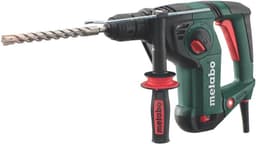
Fit the auxiliary handle before the first hole, and keep both hands on the tool. The KH 18 scope lists a rubber-coated side handle and a depth guide. The KHEV bullets describe a decoupled handle. If the handle is missing, stop. Set the depth rod, then check the far side of the wall. Seat an SDS bit of the shank that tool uses, until it clicks. SDS-plus bits belong in the KHA, the KH 18 and the KHE 3251 listing. SDS-max bits belong in the KHEV. The KHE listing accepts cylindrical shanks with no impact, so a twist bit in that Quick chuck is not your concrete bit. Fit a charged pack on a cordless body, use a BS 1363 plug on a corded listing, and change mode only with the motor stopped.

Hammer drilling

Mark the hole, put the bit on the mark, and let the hammer do the work. Lean enough to stop the bit walking, and ease off if the motor bogs. On the KH 18, set the depth guide so a frame fixing stops where you intended, for example at 60 mm. Start square. Use hammer drilling only with an SDS bit the holder accepts. If the bit stops cutting, pull it out, clear the dust, and go back in. The KHA bullets do not state a mode list. If you cannot see a hammer setting the listing describes, read the manual for that order before you guess. S-automatic on the KHA is a jam clutch.

Chiselling

Chisel only where the listing states the function. The KH 18 bullets state chiselling. The KHEV bullets state hammer drilling and chiselling, and they do not state a plain drill mode. The KHA bullets do not state a chisel mode. One UK review praises a hammer-only setting on a KHA, and that sentence does not upgrade the bullets. Do not copy a DeWalt or Hilti mode diagram onto the Metabo selector. Stop the motor, then move the selector, and set a chisel so the edge points where you want the waste to go. Keep the edge flat, take a shallow pass, and leave the side handle on.

Dust, noise and hands

Masonry dust is covered by HSE construction sheet CN3. Indoors, that means extraction or suitable suppression, and a mask rated for the dust. Hearing protection belongs where declared sound pressure sits above 85 dB(A). The Control of Noise at Work Regulations 2005 set action values at 80 and 85 dB(A) and a limit at 87 dB(A). Metabo's KHEV sheet states 96 dB(A). A KH 18 manual mirror lists 90 dB. Do not treat the mirror as a number printed on the amazon.co.uk row.

Stop

Stop when you cannot account for what is in the wall. If you do not know where cables and pipes run, get someone who can locate them before you continue. Stop if the chuck releases the bit, which reviewers have described on the KHE listing, and stop if the trigger does nothing while a light stays on, as one UK review of the KHEV reported on 29 April 2026. Unplug or remove the pack. Stop for a lintel, a structural opening, or a chase that has become demolition. A jam is the same kind of stop: release the trigger, wait until the motor is still, then free the bit. The Metabo SDS drill buying guide sets out the mode gaps.

Common questions

Can I change mode while the motor is running?
No. Release the trigger and wait until the motor has stopped, then move the selector. These listings do not print a Metabo switch diagram. Guessing the positions from a DeWalt page can put the bit in the wrong function.
Which of these listings actually states a chisel function?
The KH 18 bullets state chiselling, and the KHEV bullets state chiselling. The KHA bullets do not, even though one UK review mentions hammer-only. The KHE bullets name rotation stop and hammer stop, and they state no impact for cylindrical shanks.
How hard should I push?
Push enough to keep the bit on the mark, and let the hammer's blow do the cutting. If the motor slows or the bit stalls, back out and clear the dust. On the KHA, the S-automatic clutch may release in a jam. That is a warning to stop, not a cue to lean harder.
When is the trigger time long enough to stop?
HSE's hammer-action screening is about 15 minutes above the 2.5 m/s² A(8) action value and about an hour toward the 5 m/s² limit. Use that as a screen, not as your personal limit. If the work has become sustained breaking, stop and hand it on.
What if the bit jams or the chuck releases?
Release the trigger and wait until everything has stopped, then free the bit. Do not change mode while it is still turning. If the chuck has let the bit go, as some KHE reviews describe, retire the tool until you know why. A dead trigger with a light still on, as in the KHEV review of 29 April 2026, is the same kind of stop.

Related pages

Sources

Public UK sources listed below, last checked on 22 October 2026. Shelf prices and star lines are the amazon.co.uk figures for these four listings.

  1. Metabo UK, cordless hammers (retrieved 22 October 2026)
  2. KH 18 LTX BL 24 sheet, 601713840 (retrieved 22 October 2026)
  3. Metabo UK SDS booklet (retrieved 22 October 2026)
  4. Metabo, KHE 3251, 600659000 (retrieved 22 October 2026)
  5. Metabo, KHEV 5-40 BL, 600765500 (retrieved 22 October 2026)
  6. HSE, hand-arm vibration regulations (retrieved 22 October 2026)
  7. HSE, assessing hand-arm vibration risk (retrieved 22 October 2026)
  8. HSE, construction dust sheet CN3 (retrieved 22 October 2026)
  9. Control of Noise at Work Regulations 2005 (retrieved 22 October 2026)