How to use a hinge drill bit
You have a sprung guide in the chuck and a butt hinge on the bench. The nose has to be seated before the drill starts, and the sleeve will not cut a full-length hole for a 30 mm screw. Seat it, drill square, clear the dust, and stop when the job is no longer scrap. Which set to buy stays on the [hinge drill bit comparison](/hub/drilling-and-accessories/hinge-drill-bit). Review themes are from amazon.co.uk on 21 October 2026, plus public UK safety pages. There is no lab test. A qualifying purchase through our links can earn a commission at no extra cost to you.
You have a sprung guide in the chuck and a butt hinge on the bench. The nose has to be seated before the drill starts, and the sleeve will not cut a full-length hole for a 30 mm screw.
You have a sprung guide in the chuck and a butt hinge on the bench. The nose has to be seated before the drill starts, and the sleeve will not cut a full-length hole for a 30 mm screw. Seat it, drill square, clear the dust, and stop when the job is no longer scrap. Which set to buy stays on the hinge drill bit comparison. Review themes are from amazon.co.uk on 21 October 2026, plus public UK safety pages. There is no lab test. A qualifying purchase through our links can earn a commission at no extra cost to you.
Our top picks
| Badge | Product | Sizes in the box | Centring | Shank | Note | Price | Offer |
|---|---|---|---|---|---|---|---|
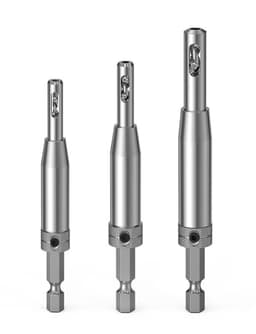
| Best overall |  Trend Trend QR/DBG/SET 3-piece guide | No.6 2.4 mm, No.8 2.8 mm, No.10 3.6 mm | Sprung sleeve. Reviews say it stops early | 1/4 inch hex | 9.0 | about £15.95 | View offer |
| Best value |  Ancable Ancable 2.4 / 2.8 / 3.6 mm set | 2.4 mm, 2.8 mm, 3.6 mm | Self-centring tip. Side gaps for dust | 1/4 inch hex | 8.5 | about £9.99 | View offer |
 KAHEIGN KAHEIGN self-centring set | 5/64 to 1/4 inch, two of 9/64 inch, plus 5 mm | Positioning centre and side holes | Hex | 7.3 | about £9.99 | View offer |


On this page
What the sleeve is for
Drill one pilot
When it clogs or stops short
When to put the drill down
Common questions
Do I mark the hole or sit the bit in the countersink?
How deep will the sleeve go?
What do I do when the sleeve sticks?
Should I use an impact driver or hammer mode?
How do I know the pilot is centred?
When do I stop and call a joiner?
Does this method cut a 35 mm cup?
Related pages
Sources
Public sources from the research digest, last checked on 21 October 2026. Shelf prices and star lines are the amazon.co.uk figures in the display file.
- Trend Snappy drill bit guides (retrieved 21 October 2026)
- Axminster professional hinge drills (retrieved 21 October 2026)
- Hart Wholesale, Blum CLIP top BLUMOTION 71B3550 (retrieved 21 October 2026)
- Hettich Sensys 110° hinge (retrieved 21 October 2026)
- DHF and GAI code of practice, hardware for fire and escape doors (retrieved 21 October 2026)
- BWF Fire Door Alliance, fire door hardware (retrieved 21 October 2026)
- HSE, PUWER overview (retrieved 21 October 2026)
- Consumer Rights Act 2015, section 9 (retrieved 21 October 2026)