40 mm or 35 mm Forstner hinge hole
The bit says 40 mm, and the title said hinge. The concealed cabinet hinge on the bench is almost certainly a 35 mm cup. A 40 mm Forstner bit can only drill 40 mm. What to check on a general listing is on the [40 mm Forstner bit buying guide](/hub/drilling-and-accessories/forstner-bit-40mm/sub/forstner-bit-40mm-buying-guide). The product table is the [40 mm Forstner bit comparison](/hub/drilling-and-accessories/forstner-bit-40mm). Blum's cup figures and a UK cabinet guide were used below, on 20 October 2026. This is not a lab test.
The bit says 40 mm, and the title said hinge. The concealed cabinet hinge on the bench is almost certainly a 35 mm cup. A 40 mm Forstner bit can only drill 40 mm.
The bit says 40 mm, and the title said hinge. The concealed cabinet hinge on the bench is almost certainly a 35 mm cup. A 40 mm Forstner bit can only drill 40 mm. What to check on a general listing is on the 40 mm Forstner bit buying guide. The product table is the 40 mm Forstner bit comparison. Blum's cup figures and a UK cabinet guide were used below, on 20 October 2026. This is not a lab test.
Our top picks
| Badge | Product | Listed diameter | Pieces | Machine note | Note | Price | Offer |
|---|---|---|---|---|---|---|---|
| Best overall |  TA-VIGOR TA-VIGOR 40 mm, carbide tip | 40 mm | 1 | Bench drill, vertical drill or CNC; water on hardwood | 7.0 | about £9.46 | View offer |
 ASNOMY ASNOMY 40 mm, carbide tipped | 40 mm (minimum bore printed as 1.56 inches) | 1 | Above 40 mm, listing prefers a fixed drill or a vice | 8.5 | about £11.89 | View offer | |
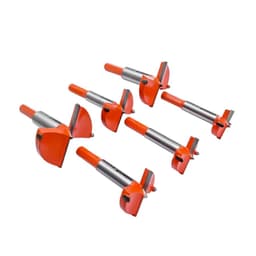
| Alternative |  YOKOCUT YOKOCUT 6-piece set, 30–60 mm | 30–60 mm, including 40 mm | 6 | Drill press; reviews say larger bits walk in a hand drill | 6.6 | about £18.72 | View offer |


On this page
The cup is 35 mm unless the drawing says otherwise
The C-dimension
Depth and the centre point
When 40 mm is actually the hole
Common questions
What diameter is a concealed cabinet hinge?
How deep is the cup?
Can a 40 mm Forstner bit drill a 35 mm cup?
What is the C-dimension?
Will the centre point come through a 16 mm door?
Is a hinge boring bit different from a Forstner bit?
Related pages
Sources
Public UK sources from the research digest, last checked on 20 October 2026. Shelf prices and star lines are the amazon.co.uk figures in the product display for this comparison.
- HSE: PPE overview (retrieved 20 October 2026)
- Consumer Rights Act 2015, section 19 (retrieved 20 October 2026)
- Bosch Professional UK, 40 mm Forstner bit 2 608 577 019 (retrieved 20 October 2026)
- Hart Wholesale, Blum 71B3550 (retrieved 20 October 2026)
- Furnica, 35 mm hinge cup guide (retrieved 20 October 2026)
- Katz-Moses Tools, Forstner speeds (US shop, rule of thumb) (retrieved 20 October 2026)
- Famag Tool UK, classic 40 mm Forstner bit (retrieved 20 October 2026)
- amazon.co.uk listings for the ASINs in this comparison (retrieved 20 October 2026)