HSS or cobalt drill bits
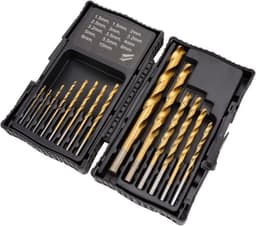
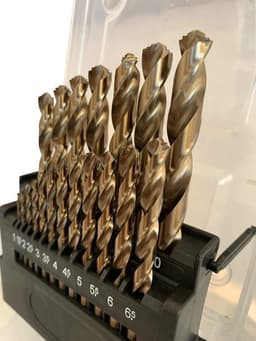
You are holding a gold bit in one hand and a stainless bracket in the other, hoping the colour is enough to finish the hole. It is not. HSS or cobalt drill bits is one decision: high-speed steel for mild steel and aluminium, a titanium nitride coat still counted as HSS, and the M42 listing only when the hole is stainless, at low speed and with oil. Prices are the amazon.co.uk lines in the [drill bit comparison](/hub/drilling-and-accessories/drill-bit). Products Compared used those listings and UK trade guides on 22 October 2026, and did not run a lab test. A qualifying purchase can earn a commission at no extra cost to you.
You are holding a gold bit in one hand and a stainless bracket in the other, hoping the colour is enough to finish the hole. It is not.
You are holding a gold bit in one hand and a stainless bracket in the other, hoping the colour is enough to finish the hole. It is not. HSS or cobalt drill bits is one decision: high-speed steel for mild steel and aluminium, a titanium nitride coat still counted as HSS, and the M42 listing only when the hole is stainless, at low speed and with oil. Prices are the amazon.co.uk lines in the drill bit comparison. Products Compared used those listings and UK trade guides on 22 October 2026, and did not run a lab test. A qualifying purchase can earn a commission at no extra cost to you.
Our top picks
| Badge | Product | Steel or tip | Diameters | Stainless named | Note | Price | Offer |
|---|---|---|---|---|---|---|---|
| Best overall |  Bosch Bosch PointTeQ 19-piece HSS | HSS, black oxide, PointTeQ tip | 1.0–10.0 mm in 0.5 mm steps | No | 8.4 | about £14.12 | View offer |
| Alternative |  Amazon Basics Amazon Basics 14-piece HSS | HSS; title says titanium, finish says polished | 1.5–10 mm, with 1.5 and 3.2 mm repeated | Excluded in the usage note | 7.7 | about £9.12 | View offer |
| Alternative |  STROTON STROTON M42 cobalt 19-piece | M42 8% cobalt | 1–10 mm in 0.5 mm steps | Yes | 6.8 | about £37.89 | View offer |

On this page
HSS for mild steel, aluminium and plastic
A titanium nitride coat is still HSS
Cobalt when the listing says M42 and the job is stainless
Low speed and oil, or the bit is wasted
Common questions
Should I buy HSS or cobalt drill bits?
Is a gold titanium drill bit cobalt?
What is M42, and which listing here says it?
Can HSS drill stainless steel?
Why do the STROTON angle lines disagree?
Related pages
Sources
Public UK sources from the research digest. Shelf prices and star lines are the amazon.co.uk figures in the display file.
- HSE CN3: silica dust and APF 20 (retrieved 22 October 2026)
- HSE CIS36: drilling and respirable crystalline silica (retrieved 22 October 2026)
- HSE: electricity, drilling near cables (retrieved 22 October 2026)
- HSE CIS65: power off if cable routes are unknown (retrieved 22 October 2026)
- Bosch DIY UK: guide to drills (retrieved 22 October 2026)
- Screwfix: guide to types of drill bits (retrieved 22 October 2026)
- Rawlplug UNO universal plug (retrieved 22 October 2026)
- CMT: standard plastic wall plugs (retrieved 22 October 2026)