Independent comparisons. We may earn from shop links. More info

How to use a DeWalt rotary hammer

Updated: 2026-10-23

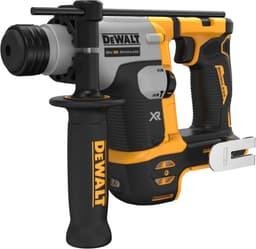
You have the DeWalt SDS Plus hammer in your hand, and the hole in the brick or the lintel is the job. Seat the bit, set hammer-drilling mode, and let the piston cut while you clear the dust. The sequence fails when the selector is on rotation only, or when the bit is not fully home. What each box contains is on the [DeWalt rotary hammer comparison](/hub/drilling-and-accessories/de-walt-rotary-hammer). A qualifying purchase can earn a commission at no extra cost to you.

You have the DeWalt SDS Plus hammer in your hand, and the hole in the brick or the lintel is the job. Seat the bit, set hammer-drilling mode, and let the piston cut while you clear the dust.

Our top picks

On this page

Seat the bit and set the mode

An SDS Plus bit locks in the holder. It is not in the D25133K box or the bare DCH172N box. Push it in and turn it until it will not pull out by hand. A bit that is only part-way in drills a wandering hole. For an 8 mm plug, use an 8 mm SDS Plus masonry bit. Set the mode only when the tool is stopped. For brick, block or concrete, select hammer drilling. Rotary only is for wood or metal, and it will glaze masonry. Two symbols means you are on a DCH172. Hammer drilling is the masonry mode, and the manual tells you not to fit a chisel bit. If there is no hammer-only symbol, that limit is chisel mode, not a fault in this sequence. On the D25133, hammering-only is for light chiselling. Stop the tool before you turn the collar. Reverse is for a stuck bit. It is not how you drill the hole.

Side handle and depth

Leave the side handle on. Some reviewers use the DCH172 in one hand, and a jammed bit still twists the wrist. The D25133 description cites a mechanical clutch. The DCH172 manual lists a mode selector and a forward/reverse lock, not a named anti-kick system. Set the depth rod from the tip of the bit to the tip of the rod, to the fixing's embedment. A 40 mm plug does not need a 150 mm hole. Keep the bit square to the wall, and keep the lead or the battery clear of the cut. On a ladder, the DCH172 lanyard point holds the tool. It does not hold you. Check the depth stop after the first hole. Vibration walks a loose rod, and a slipped stop will not keep the bit out of a cavity or a cable zone.

Drill, then clear the hole

Start slowly, then let the speed come up. Do not lean on the hammer. Forcing it is how reviewers of the D25133 describe the tool getting hot. No temperature is printed, so ease off and clear the dust. If the bit walks, stop and start again on the mark. UK SDS guidance suggests withdrawing every 20–30 mm so the flutes empty. That interval is a rule of thumb, not a DeWalt limit and not a vibration limit. Vacuum the dust out before a plug or resin goes in. A hole packed with dust holds a fixing badly. HSE's CN3 sheet says to check for utilities and to use on-tool extraction when the work is more than a one-off hole. When you are not extracting, that sheet calls for respiratory protection at APF 20. Masonry dust can contain silica. If the bit jams, release the trigger and use reverse to ease it out.

Protection, and when to stop

Wear eye protection and hearing protection. Declared sound pressure sits around 84–92 dB(A). The D25133 manual states 92 dB(A), and the DCH172 is declared at 87 dB(A). At work the action values are 80 dB(A) and 85 dB(A), and the limit is 87 dB(A). Drilling vibration is 8.8 m/s² on the DCH172 and 16 m/s² on the D25133. The daily action value is 2.5 m/s² A(8) and the limit is 5 m/s² A(8). HSE says hammer-action tools for more than about 15 minutes a day may be a vibration problem. That is a class illustration, not a permitted time. Stop for a structural opening, for cables or pipes you cannot locate, and for work at height that needs more than a clip on the tool. Also stop if the hammer action has failed, the chisel lock no longer holds, or the motor smokes.

Common questions

Which mode do you use for brick or concrete?
Use hammer drilling, the setting that rotates and hammers together. Rotary only will polish masonry. On a DCH172, hammer drilling is the masonry symbol. On a D25133, hammering-only is for light chiselling, not for the hole. Change mode only with the trigger released.
How do you fit an SDS Plus bit and the depth rod?
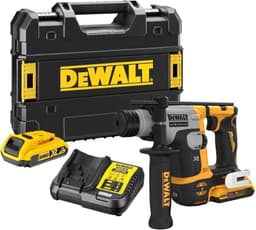
Push the bit in and turn it until it will not pull out. Set the rod from the tip of the bit to the tip of the rod, to the plug depth, not the bit length. The D25133K box is a TSTAK, a side handle and a depth stop. The DCH172N box is the bare unit.
Why must the side handle be on?
A jammed bit twists the wrist, including on the light DCH172 that some reviewers hold in one hand. The side handle is the second grip and it carries the depth rod. The DCH172 manual does not name a separate anti-kick system.
How do you clear dust so a fixing seats?
Withdraw the bit so the flutes empty, then vacuum the hole before the plug or resin. For more than a one-off hole, HSE CN3 points to on-tool extraction. Respiratory protection at APF 20 applies when you are not extracting. Dry sweeping spreads masonry dust, which can contain silica.
When do you stop and call a professional?
Stop for a structural opening, for unknown cables or pipes, and for work at height beyond the lanyard point. That point holds the tool, not the person. Stop if the hammer action has failed or the chisel collar no longer locks. This sequence assumes you already know the wall is clear.

Related pages

Sources

Public UK sources from the research digest, last checked on 19 October 2026. Shelf prices and star lines are the amazon.co.uk figures in the display file.

  1. DeWalt DCH172 instruction manual (retrieved 19 October 2026)
  2. DeWalt DCH172D2-GB product page (retrieved 19 October 2026)
  3. DeWalt D25133 instruction manual (retrieved 19 October 2026)
  4. DeWalt DCH033 instruction manual (retrieved 19 October 2026)
  5. Control of Vibration at Work Regulations 2005, regulation 4 (retrieved 19 October 2026)
  6. HSE INDG175: hand-arm vibration (retrieved 19 October 2026)
  7. Control of Noise at Work Regulations 2005, regulation 4 (retrieved 19 October 2026)
  8. HSE: electrical systems on construction sites (retrieved 19 October 2026)