Independent comparisons. We may earn from shop links. More info

82 or 90 degree countersink: match the screw in your hand

Updated: 2026-10-23

An 82 or 90 degree countersink is the angle of the cone that has to meet the underside of one screw. Use the wrong cone and the head sits on a thin ring, or it bites near the shank and leaves a gap. This page separates woodscrews, metric socket screws and old Whitworth stock, then shows what the twelve amazon.co.uk listings in the [countersink drill bit comparison](/hub/drilling-and-accessories/countersink-drill-bit) actually print. Products Compared read those listings on 19 October 2026. We did not measure a batch of screws, and we did not run a lab test. A qualifying purchase can earn a commission at no extra cost to you.

An 82 or 90 degree countersink is the angle of the cone that has to meet the underside of one screw. Use the wrong cone and the head sits on a thin ring, or it bites near the shank and leaves a gap.

Our top picks

On this page

Two cones, two seats

A countersunk head is a cone. When the angles agree, the head bears on the whole seat and can finish flush. When the bit is sharper than the head, the head often meets the hole near the shank and the rim stands proud. When the bit is flatter, contact moves out to the rim and you see a shadow under the head. Cromwell's countersink notes describe a cone that bites and breaks the surface, or a chamfer that is too shallow and leaves a gap. Softwood hides a small mismatch better than oak. Do not plan on pine to correct a 90° screw in an 82° seat on a painted MDF door. Set the stop on the how to use a countersink drill bit page only after you know which angle you are cutting. Workshopshed's UK note puts Unified inch screws in the 82° family and aircraft work often at 100°.

What the standards actually separate

ISO metric hexagon socket countersunk screws are the 90° family. BS EN ISO 10642 is the British adoption of that fastener standard. It is about seating the head and about reduced loadability compared with a cap screw. It does not say a cabinet woodscrew is a 90° screw. A countersunk socket screw is not as strong in tension as a cap head of the same size, so you do not improve a specified joint by countersinking it deeper. Unified inch screws, UNC and UNF, are the 82° side. Wikipedia's countersink summary states 82° for American inch screws and 90° for ISO metric. Performance Fasteners marks UNC/UNF socket countersunk heads at 80/82, and BSW and BSF nearer 89/91. Wikipedia also says 100° for BA, BSF and BSW. Both figures are in circulation. Neither is a survey of the Pozidriv woodscrews in a Screwfix tub. The screw you just removed from the hinge outranks both. Pilot diameters, once the angle is chosen, are on the countersink drill bit for wood page.

What these listings print

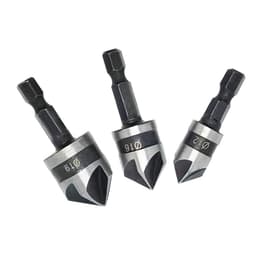
Six combined wood sets state 82°: NORTOOLS, DECKRKAT, the EZARC 15-piece, the EZARC 22-piece, TOLESA and the EZARC 12-piece. That is the cone they are selling for #4 to #12 labels. It is not proof that every UK woodscrew is 82°. Three listings state 90°: Kaquxibix, ATOPLEE, and Torveen's title. Torveen's spec table also prints 9E+1 Degrees. We do not silently edit that cell. These are chamfer tools. ATOPLEE adds round shanks and a ban on hand drills. PATNFR and TMBMLPP print nothing. Makita's D-73455 prints 6E+1 Degrees. We do not turn that into 60°, and we do not assume it meant 82°.

Prove it on scrap

Take one screw from the box you will use. Drill one hole in offcut of the same material, at a shallow stop. If you see a gap around the rim, try the other common angle before you deepen the hole. Hardwood and brass show the fault sooner than pine. Do not average the sources into UK screws are 90° and then buy only ATOPLEE. Do not treat the six 82° kits as correct for a metric socket screw in a machine bracket. If the scrap screw sits cleanly, the remaining work is depth and pilot size.

Common questions

Are UK wood screws 90°?
Not as a rule you can shop with. Metric socket countersunk screws in BS EN ISO 10642 are the 90° family. Unified inch screws are 82°. British inch socket tables in the Performance Fasteners sheet sit near 90°, while a Wikipedia summary says 100° for BSW, BSF and BA. Ordinary Pozidriv woodscrews are not settled by those lines. Read the screw you are fitting, then test it.
Why do amazon.co.uk wood sets say 82°?
Because the combined kits aimed at #4 to #12 screws have followed the Unified inch countersink. NORTOOLS, DECKRKAT, TOLESA and the three EZARC wood sets in this comparison all print 82°. That is a product claim, not a finding that every screw sold in Britain is 82°. A metric machine screw can still want 90°.
What happens if the angles do not match?
The head bears in the wrong place. Cromwell's trade note describes a cone that bites and breaks the surface, or a shallow chamfer that leaves a gap. You see a proud rim, a crushed ring, or a shadow under the head. Softwood compresses and hides a small error. Hardwood, brass and paint show it. Deepening the hole does not fix the angle.
Is 100° a real countersink I might meet?
Yes, on many aviation fasteners and, in Wikipedia's summary, on BA, BSF and BSW. The socket-screw table used here marks BSW and BSF nearer 89/91, so 100° is not the only British inch figure in circulation. None of the twelve listings prints 100°. If the screw you removed is a wide, flat aircraft-style head, these sets are the wrong cone.
What is Makita's 6E+1 angle?
It is the string in the amazon.co.uk spec table for the D-73455, 6E+1 Degrees. This page does not convert it to 60° and does not assume a missing 82. The other depth cell that says 11m for the No.6 minimum shows the same listing can print a broken figure. Treat the angle as unresolved until you have a Makita drawing or a scrap test that satisfies you.

Related pages

Sources

Public UK sources from the research digest, last checked on 19 October 2026. Shelf prices and star lines are the amazon.co.uk figures in the display file.

  1. HSE: PUWER overview (retrieved 19 October 2026)
  2. HSE WIS23: wood dust (retrieved 19 October 2026)
  3. HSE: cutting and sanding wood (retrieved 19 October 2026)
  4. HSE L25: eye protection (retrieved 19 October 2026)
  5. GOV.UK: General Product Safety Regulations 2005 (retrieved 19 October 2026)
  6. Consumer Rights Act 2015, section 20 (retrieved 19 October 2026)
  7. Screwfix: screws buying guide (retrieved 19 October 2026)
  8. BSI: BS EN ISO 10642:2019 (retrieved 19 October 2026)