Independent comparisons. We may earn from shop links. More info

Aviation snips vs tin snips

Updated: October 2026

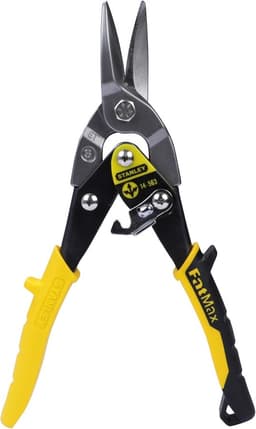
Both tools are sold as tin snips, and the photo looks like the same shears until you count the pivots. Aviation snips vs tin snips is that fork: a compound pair with a second pivot and a spring, or a traditional straight snip with a simpler action. You are choosing a mechanism for thin sheet, not a colour and not a league table. Red, yellow, and green belong on [left or right tin snips](/hub/diy-supplies/tin-snips/sub/tin-snips-left-or-right). Prices sit on the [tin snips comparison](/hub/diy-supplies/tin-snips). Peter F. compared these amazon.co.uk listings on 16 October 2026, using RS Components' category note for the pattern names. There was no lab test. A qualifying purchase can earn a commission at no extra cost to you.

Both tools are sold as tin snips, and the photo looks like the same shears until you count the pivots.

Our top picks

On this page

Two tools under one name

RS describes aviation snips as compound, dual-pivot, and usually spring-loaded, often colour-coded for the direction of the cut. Traditional tin snips on the same page are the straight, curved, duckbill, or bulldog patterns. They do not use a second pivot to multiply hand force. In this set the traditional example is the Rolson 22157. The compound examples include Stanley FatMax, Amazon Basics, HOUSERAN, Milwaukee, and the Hurricane set. On a compound pair your grip closes a linkage, and the linkage closes the jaws. On a traditional pair your hand closes the jaws more directly. You feel the thickness sooner. Compound leverage does not raise you above a printed gauge. If the listing has no gauge, you still do not know the limit.

When compound action earns its place

Choose compound aviation snips when the sheet is near a stated 1.2 mm mild-steel claim, or when a long straight cut would tire you on a single-pivot tool. Amazon Basics, at £7.38, prints that claim: up to 18-gauge mild steel (1.2 mm) and up to 22-gauge stainless, with serrated chrome-vanadium blades and a lock. Reviewers cut mesh and fencing. They also report a pivot that loosened, an edge that dulled, and a stainless strip that kinked. Stanley FatMax, at £13.76, names serrated edges, a double pivot, and 250 mm, with 4.7 from 15,389 reviews. The amazon.co.uk bullets do not print a gauge. Stanley's UK page for 2-14-563 does state 1.2 mm. Do not paste it into the empty Amazon cell. A spring opens the jaws between bites. A latch is for storage. Hurricane buyers report latches that do not catch.

When a traditional straight snip is enough

The Rolson 22157 is £5.70, rated 4.5 from 696 reviews, with hardened steel blades and a stated length of 250 mm. It is a straight tin snip, not an aviation pair, and the bullets do not state a gauge. Reviews describe clean cuts on galvanised sheet and aluminium. One reviewer kept a personal limit near 0.8 mm mild steel. That is one person's ceiling, not a printed capacity. The repeated fault is the spring. It pops out when the rivets are loose, and the bullets name no safety latch. A traditional straight snip is enough for the odd thin galvanised offcut, when you do not need left and right jaws. It is the wrong tool near 1.2 mm for more than a few strokes. Serrated aviation jaws grip sheet that wants to slip, and they can leave a coarser edge.

A title is not a mechanism

Sharp-tec is the warning. The listing is an 8 inch offset snip at £12.99, 4.2 from 134 reviews, and the title uses aviation language. The bullets name an offset jaw and a lock, and they do not print a gauge. Satisfied reviewers talk about chicken wire and thin mesh. Others say it feels like heavy scissors rather than aviation snips. Until you can see a second pivot, do not treat the word aviation as settled. Milwaukee describes compound leverage, but the sample is 5.0 from six reviews and the only written note says the buyer had not used them. HAUTMEC states a 20-gauge mild-steel limit, thinner than 1.2 mm. Who ranks as top pick on review volume is best tin snips. The bite that avoids a notch is how to use tin snips.

Common questions

What is the difference between aviation snips and tin snips?
In trade categories, aviation snips are the compound pattern: two pivots, usually a spring, often a colour for cut direction. Traditional tin snips are the older straight or curved shears without that second pivot. Shops still file both under tin snips, which is why Rolson and Stanley can appear in one list. The pivot count is the check. A marketing word in the title is not.
When is a traditional straight snip enough?
When the offcut is thin, straight, and occasional, and you do not need a stated 1.2 mm. The Rolson at £5.70 is that tool here. Reviews mention galvanised sheet, a spring that escapes loose rivets, and one personal limit near 0.8 mm. It is not enough when the cut is long, near the thicker mild-steel claims, or curved in both directions.
What does the second pivot change?
It multiplies hand force through a linkage, so a compound pair takes less effort at the same thickness. It does not raise the safe thickness above a printed gauge. You still stop when the sheet kinks. Amazon Basics states 1.2 mm mild steel. Stanley's Amazon bullets do not, even though the manufacturer page does.
Why do aviation snips have a spring and a latch?
The spring opens the jaws for the next bite on a long trim. The latch holds them shut in storage. Hurricane reviews include latches that do not catch. The Rolson listing has no latch. A failed latch does not remove the compound action. It only means you should restrain the jaws before they ride loose in a bag.
Is every aviation title in this set actually compound?
No. Stanley, Amazon Basics, HOUSERAN, Milwaukee, and Hurricane describe a double pivot, double lever, or compound action. Sharp-tec's aviation wording is disputed by reviewers who call it heavy scissors for thin metal. Read the pivot sentence. If it is missing, believe the reviews that describe the feel, not the first word of the title.

Related pages

Sources

Public UK sources on cut direction, sheet gauge, sharp edges, gloves, and repair or replacement. Prices, stars, and review counts are the amazon.co.uk listing figures in this set. Prices move. There was no laboratory cut test.

  1. RS tin snips category (retrieved 17 October 2026)
  2. Stanley UK, FatMax 2-14-563 (retrieved 17 October 2026)
  3. MLC sheet metal gauge chart (retrieved 17 October 2026)
  4. V&F sheet metal gauge table (retrieved 17 October 2026)
  5. HSE EIS16, sharp edges (retrieved 17 October 2026)
  6. HSE glove selection (retrieved 17 October 2026)
  7. BuildWiz, tin snips (retrieved 17 October 2026)
  8. Consumer Rights Act 2015, section 23 (retrieved 17 October 2026)