Independent comparisons. We may earn from shop links. More info

How to set up a Stanley plane

Updated: October 2026

A new Stanley plane often will not take a fine shaving until you check the sole, hone the iron, and set the chipbreaker on a Bailey bench plane. How to set up a Stanley plane means that order. It is not a promise that the tool arrived sharp. Which type to buy is on the [Stanley plane buying guide](/hub/diy-supplies/stanley-plane/sub/stanley-plane-buying-guide), and the first buy for a face is on the [best Stanley plane](/hub/diy-supplies/stanley-plane/sub/stanley-plane-best) page. The full set is on the [Stanley plane comparison](/hub/diy-supplies/stanley-plane). Peter F. used Stanley's UK iron page. There is no lab test.

A new Stanley plane often will not take a fine shaving until you check the sole, hone the iron, and set the chipbreaker on a Bailey bench plane. How to set up a Stanley plane means that order.

Our top picks

On this page

Check the sole before you trust it

Retract the iron. You are testing the casting, not cutting. Wonkee Donkee's method uses a known-flat reference, such as plate glass, marble, or granite, with abrasive on that surface. The places that matter are the toe, the mouth, and the heel. A hollow at the mouth stops a fine shaving. Start around 120 grit and move towards about 220 to 400 only on the spots that still show. No source here requires a mirror sole. Stop if the casting is cracked. On the 5-12-020, a front plate that sits proud of the sole has to be flush before a finer grit helps. Once the toe, mouth, and heel show contact, stop and hone.

Hone an iron that is ground, not finished

Stanley's UK page for iron 0-12-313, named for the No. 4, says it is ground at 25° and ready for honing. A bevel that still needs work matches that line. It is not, by itself, a faulty plane. Small Workshop describes a Bailey iron bevel-down on a frog at about 45°. The hone does not change that cutting angle. Hone around 30° so the relief is about 15°. Do not treat 30° as a new cutting angle. The amazon.co.uk bullet says a 45 mm cutter and 245 mm. Stanley's UK page says 50 mm and 250 mm. Hone the iron in the plane you hold. Keep the back flat at the edge. If the iron is chipped, hone back to sound steel first. The chipbreaker gap is measured from a finished edge, so the hone comes first.
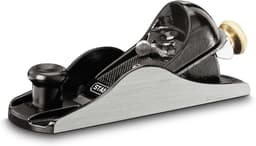
Stanley Stanley 220 block plane

Testsieger

Stanley Stanley 220 block plane
7.2/10about £29.43

Set the chipbreaker on a Bailey plane

This step is for a Bailey bench plane only. The block planes, the Surform, the kanna, and the chamfer plane do not use it. Wonkee Donkee's check is a light test: no light between the chipbreaker and the back of the iron. If you see light, shavings jam underneath. The gap from that leading edge to the cutting edge is about 0.4 mm to 3 mm. Use the smaller end for a fine shaving and the larger end when you are reducing thickness. The depth-adjuster yoke has to sit in the chipbreaker slot. If it misses, the wheel turns and the iron does not move. A thick shaving, or a cut against the grain, tears the face. If you get dust, look at the edge and the gap before you lean harder.

Take one light shaving, then stop

Clamp the wood. The iron cuts skin, so retract it or lay the plane on its side between cuts. Set a cut you can barely see, and plane with the grain. If it chatters, look for a wide chipbreaker gap, a dull edge, or a hollow at the mouth. Do not add force to hide those. On the block planes, hone, check the sole, and set a light cut. Skip the Bailey chipbreaker. Do not add a bed angle to a bevel and call the sum the cutting angle. Stop if the handle or the casting is cracked. Which? summarises a 30-day right to reject under the Consumer Rights Act 2015. If the door rubs, hinges come first, on how to plane a sticking door. A qualifying amazon.co.uk purchase can earn us a commission at no extra cost to you.

Common questions

Does a new Stanley plane arrive ready to cut finely?
Often it does not. Reviews of new Stanley planes in this band mention lapping and sharpening first. Amazon Basics reviews are mixed on arrival sharpness. Say often needs work. Check the sole with the iron retracted, then hone. Do not assume the plane is blunt every time, and do not assume it is ready.
How do you check a sole without a flatness standard?
Use a known-flat surface, such as plate glass, marble, or granite, with the iron retracted, and read the scratch pattern. Watch the toe, the mouth, and the heel. A hollow at the mouth is the fault that matters. There is no British Standard for this in the sources used here. Stop if the casting is cracked.
What angle do you hone on a Bailey plane?
The No. 4 replacement iron is described as ground at 25° and ready for honing. The frog presents it bevel-down at about 45°, so the hone does not change the cutting angle. Hone around 30°, for a relief of about 15°. The exact degree is not critical.
How close should the chipbreaker sit?
On a Bailey plane it must meet the iron with no light gap. The set-back is about 0.4 mm to 3 mm: smaller for a fine shaving, larger when you are reducing. Block planes in this set do not use that sequence. If the wheel does not move the iron, the yoke has missed the slot.
What changes on a block plane?
You still check the sole, hone, and take a light cut with the grain. You skip the chipbreaker and the 45° frog. The 1-12-020 prints no degree. The 5-12-020 listing says 21°, and reviews mention a front plate proud of the sole. Do not invent a combined cutting angle for the three listings.
When should you stop?
Stop if the casting or the handle is cracked, or if closing a hollow means grinding away a lot of sole. A bevel that needs honing matches ready for honing. A cracked handle does not. For a deep cut, or work at height over a stair, get help. A rubbing door is a hinge problem first.

Related pages

Sources

Public UK sources on hand planes, workplace equipment, and faulty goods. Listing prices and star counts are the amazon.co.uk figures kept for this comparison, October 2026. Prices move.

  1. Stanley Tools UK, No. 4 smoothing bench plane 1-12-004 (retrieved 17 October 2026)
  2. Stanley Tools UK, 50 mm bench plane iron 0-12-313 (retrieved 17 October 2026)
  3. PUWER 1998, regulation 4 (retrieved 17 October 2026)
  4. HSE, Safe use of woodworking machinery (L114) (retrieved 17 October 2026)
  5. BuildWiz, UK hand-plane guide (retrieved 17 October 2026)
  6. Small Workshop, bench plane sharpening angles (retrieved 17 October 2026)
  7. Checkatrade, how to plane a door (retrieved 17 October 2026)
  8. Which?, what to do with a faulty product (retrieved 17 October 2026)