Independent comparisons. We may earn from shop links. More info

Bootlace ferrules for a consumer unit

Updated: 23 October 2026

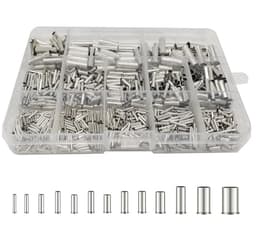
You have seen a neat row of coloured collars on RCBO leads and you are wondering whether every cable in the board needs the same treatment. Bootlace ferrules for a consumer unit are for fine-stranded ends in a screw terminal that needs that treatment. They are not the default for a cage clamp, they are not what BEAMA recommends on 19-strand meter tails, and they are not permission to replace the board. If the job is a consumer-unit change, a new circuit, or any other notifiable work, the next step is a registered electrician, not a kit. The ferrules we compared are on the [ferrule comparison](/hub/diy-supplies/ferrule). A qualifying purchase can earn us a commission at no extra cost to you.

You have seen a neat row of coloured collars on RCBO leads and you are wondering whether every cable in the board needs the same treatment.

Our top picks

On this page

The rule is the terminal, not the tidy photo

BS 7671 regulation 526.9, in the IET Wiring Matters account, requires a suitable terminal or a suitable treatment so that fine strands do not separate. A crimped bootlace ferrule is one treatment the IET names for a screw terminal. It is not a rule that every conductor in a consumer unit gets a ferrule. Solid conductors, cage clamps, and meter tails are different cases. The same IET note states 526.9.2 as a ban on soldering the whole fine-stranded end into a screw terminal, because solder can cold-flow and the joint relaxes. You crimp before you insert, with a ferrule tool, on a conductor you have isolated and proved dead. UK mains are 230 V. A CE mark on a ferrule box is not a declaration we have checked, and it does not make the board compliant.

Fine-stranded leads in a screw

Class 5 and Class 6 flexible conductors are the usual reason a ferrule exists. The strands fan under a screw, and the screw can cut the ones at the edge. A bootlace of the same mm², crimped before it is inserted, is the treatment the IET describes for that screw. Solid Class 1 cable, the sort used as 2.5 mm² ring main in twin-and-earth, takes a ferrule poorly. Ferruling it out of habit does not make a safer end. RCBO and MCB flying leads are often fine-stranded. One UK review of the flintronic kit, B0C7GJX239, says the ferrules were used to shorten RCBO cables. That is a review of a part, not a procedure, and not evidence that every flying lead should be cut down so a ferrule looks tidy. If a lead must be shortened, match the mm², and crimp with a ferrule tool before the screw sees it. None of these kits includes that tool. Size comes first, which is the bootlace ferrules buying guide, not a guess from the colour in a photograph.

Cage clamps and meter tails

A cage clamp is often designed for the bare strands. Adding a ferrule can stop the clamp closing on the copper. Practitioner discussion on IET EngX says not to add a ferrule to a terminal marked f. Treat that as discussion, not as a clause you can quote from BS 7671, and then read the device sheet. Meter tails are the other place a ferrule is the wrong default. BEAMA's installer guidance recommends flattening 19-strand tails rather than treating them as fine flex. On IET EngX, those tails are discussed as Class 2, not Class 5, and a ferrule may not fit a 100 A meter terminal. A kit that claims a 16 mm² ferrule does not turn a tail into a bootlace job. A ferrule does not create spare capacity.

Where you stop

Replacing a consumer unit, adding a circuit, and other work on a new circuit are notifiable under Part P in England. GOV.UK sets out the routes: a competent person who can self-certify, a third party, or building-control approval before you start. The register of schemes is the check, not a star rating on a ferrule kit. Start at use a competent person scheme. The Electricity at Work Regulations 1989, regulation 4, bind dutyholders, including employers. If you cannot isolate and prove dead, or you cannot name the terminal, a ferrule kit does not help. The crimp sequence for a flex on the bench stays on how to crimp a bootlace ferrule. If the work is the board, book someone on a competent-person scheme.

Common questions

Do I ferrule every cable in a consumer unit?
No. Regulation 526.9, as the IET explains it, is about a suitable terminal or a suitable treatment for fine strands. A screw on fine flex is the case for a crimped bootlace. Solid twin-and-earth, many cage clamps, and 19-strand meter tails are not that case.
What about the fine leads on an RCBO if they are cut shorter?
Fine-stranded flying leads in a screw are the sort of end a ferrule is for, and one flintronic UK review says the reviewer shortened RCBO cables with them. That review is not an instruction to cut factory leads for appearance. If a lead is shortened, match the mm² and crimp before you insert.
Do cage-clamp terminals want a ferrule?
Often they do not. The clamp is made to close on bare strands, and a ferrule can hold the copper away from the cage. A terminal marked f is discussed on IET EngX as one to leave without a ferrule. Read the device sheet. That forum line is practice, not the text of BS 7671.
Do 19-strand meter tails need one?
BEAMA's guidance recommends flattening 19-strand tails and does not tell installers to ferrule them. EngX discussion treats those tails as Class 2, not as the fine flex a bootlace is drawn for, and notes that a ferrule may not enter a 100 A meter terminal. A kit that claims 16 mm² ferrules does not overturn that.
Can I do this myself with the power off?
Switching the main switch off is not the same as proving dead, and this page does not describe how to open a consumer unit. A flex lead on the bench is a different job from any conductor inside the board. If you are not sure the conductor is dead, stop.
Who is allowed to change the consumer unit?
In England, a consumer-unit change is notifiable Part P work. GOV.UK's routes are a competent person who self-certifies, a third-party certifier, or building control before you start. The scheme register is the list that matters. A ferrule kit, and a CE line on the box, do not put you on that list.

Related pages

Sources

Public UK sources and the amazon.co.uk listings compared on this page. Listings captured 21 October 2026. Updated October 2026.

  1. IET Wiring Matters, Mythbuster #5 (March 2020) (retrieved 22.10.2026)
  2. Weidmuller UK: wire end ferrules (retrieved 22.10.2026)
  3. Phoenix Contact ferrule guide (retrieved 22.10.2026)
  4. RS PRO crimping kit 513-2540 (retrieved 22.10.2026)
  5. GOV.UK: competent person schemes (retrieved 22.10.2026)
  6. Electricity at Work Regulations 1989, regulation 4 (retrieved 22.10.2026)
  7. BEAMA consumer-unit guidance (retrieved 22.10.2026)
  8. amazon.co.uk listings B0C7GJX239, B0D8PNZSPK, B0CCTJMQ9Q, B0F8B11BC8, B09T9425PF (retrieved 22.10.2026)