Cable tidy box buying guide
A 4-gang behind the television and a drawer of spare chargers look like one mess. They are two buys. A lidded hider is for a lead that stays switched on. A clear case is for leads you have already unplugged. This cable tidy box buying guide takes the decisions in that order: the job, the fit with the plugs in, the exits and the air, the lead itself, and only then the material and the star line. Shelf prices are on the [cable box comparison](/hub/diy-supplies/cable-box). Figures are this amazon.co.uk capture from October 2026. Peter F. checked the listings, not in a lab. A qualifying purchase can earn a commission at no extra cost to you.
A 4-gang behind the television and a drawer of spare chargers look like one mess. They are two buys. A lidded hider is for a lead that stays switched on. A clear case is for leads you have already unplugged.
A 4-gang behind the television and a drawer of spare chargers look like one mess. They are two buys. A lidded hider is for a lead that stays switched on. A clear case is for leads you have already unplugged. This cable tidy box buying guide takes the decisions in that order: the job, the fit with the plugs in, the exits and the air, the lead itself, and only then the material and the star line. Shelf prices are on the cable box comparison. Figures are this amazon.co.uk capture from October 2026. Peter F. checked the listings, not in a lab. A qualifying purchase can earn a commission at no extra cost to you.
Our top picks
| Badge | Product | Job | Stated fit | Stated standard | Note | Price | Offer |
|---|---|---|---|---|---|---|---|
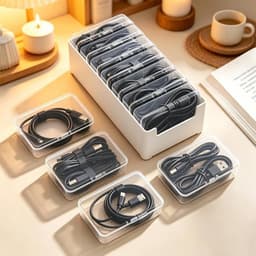
| Best overall |  Cwokarb Cwokarb cable box with 7 clear cases | Drawer caddy | Coiled leads, not a strip | No IP code | 6.5 | about £12.99 | View offer |
 D-Line D-Line cable tidy box, small, black | Extension hider | 4-gang blocks up to 280 mm | BS EN 60670-22:2006 | 9.5 | about £9.99 | View offer | |
| Best value |  GOZOLA GOZOLA rattan cable box, 2-pack | Rattan hider, two sizes | 33 × 15 × 13 cm and 28 × 10 × 10 cm | Fire claim, no number | 7.3 | about £23.99 | View offer |


On this page
A live lead and a spare lead are different buys
Fit means plugs in, not the outside of the box
Exits, air, and the lead itself
Material and review counts come last
Where that order leaves you
Common questions
Is a cable tidy box the same thing as a drawer full of chargers?
What should you measure before you trust the word large?
Will the D-Line small box take a popular UK 4-gang?
Does a BS EN 60670-22 line on one listing apply to a rattan or wood box?
Can the box make a daisy-chained or overloaded lead safe?
When do you stop buying boxes and ask for more sockets?
Related pages
Sources
Public UK sources and the amazon.co.uk listings compared on this page. Updated 22.10.2026.
- Electrical Safety First, extension leads, cable reels and block adaptors (retrieved 22.10.2026)
- BSI, BS EN 60670-22:2006+A11:2024 (retrieved 22.10.2026)
- D-Line cable tidy unit (retrieved 22.10.2026)
- D-Line cable tidy unit datasheet (retrieved 22.10.2026)
- Fire Protection Association, extension lead briefing (retrieved 22.10.2026)
- HSE, electricity introduction (retrieved 22.10.2026)
- GOV.UK, consumer product safety advice (retrieved 22.10.2026)
- Which?, faulty products and the Consumer Rights Act 2015 (retrieved 22.10.2026)