Independent comparisons. We may earn from shop links. More info

How to use an earth auger

Updated: October 2026

You have a manual flight or a powered borer, the first hole is marked, and you want the bit to cut. This is how to use an earth auger in a UK garden: check for buried services, keep both hands on the machine, cut in short lifts, and release the drive the moment the flight grabs. The six listings are in the [earth auger comparison](/hub/digging-tools/earth-auger). Peter F. compared the listings and public UK sources in October 2026. There was no lab test. A qualifying purchase can earn a commission at no extra cost to you.

You have a manual flight or a powered borer, the first hole is marked, and you want the bit to cut.

Our top picks

On this page

Before the bit touches the ground

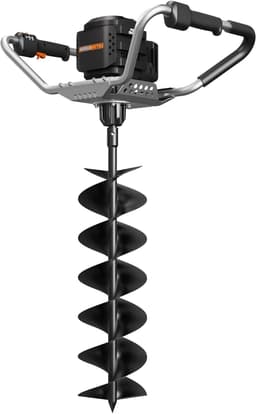
Find out what is under the line before you bore. In Great Britain, Energy Networks Association’s Think before you dig number is 105. In Northern Ireland it is 03457 643 643. If a cable is already damaged and there is immediate danger, call 999. The Health and Safety Executive’s CIS65 sheet says not to use power tools within 0.5 m of a suspected service route, and to dig alongside a service rather than straight down onto it. Plans and a cable avoidance tool are the method on a building site. Stand with a firm footing, sleeves tight, and both hands on the handles. A Doncaster Tool Hire leaflet for a one-person petrol borer tells you to be ready to stop, and that advice transfers to a cordless trigger. Do not run the bit at full speed until the tip is in the ground, or it walks across the lawn. A manual auger uses the same stance without a throttle. You twist. You do not lean your whole weight onto a flight that has already hit a stone.

Cutting the hole

The hole is made in short lifts, not one plunge. Nick the surface so the tip cannot skate, then apply light downward pressure. On a petrol hire machine the Doncaster leaflet says full throttle only after the tip is in. On the Einhell you select a clockwise mode, ECO or HIGH, once the point has bitten. Lift the flight to clear spoil. Operating notes published by Romford Fencing say about every 15–20 cm, because clay packs the screw and the tool then pulls you instead of cutting. Empty the spoil beside the hole, not back into it, and keep the shaft upright. A wandering cut is wide at the top and tight at the bottom, so the post leans once you concrete it. Fence depth is a separate decision, and it sits on earth auger for fence posts. The auger is quicker than a spade in clean soil and worse when a thick root crosses the hole. Forcing the last few centimetres is how a manual blade goes blunt in clay.

When it kicks or sticks

Release the throttle or the trigger the instant the bit stops turning. Do not add power to bully it through. UK Einhell reviews describe a snatch on roots, rocks, or old concrete, then a stop, and that snatch is what strains wrists when the handles are narrow. The Worx listing says motor power cuts if the auger jams, and the tool has reverse. The Einhell has an anti-clockwise mode. Wait until the flight has actually stopped before you reverse it or turn it out. The Doncaster leaflet, for a hired petrol borer, says stop the engine if it jams, then use the gear lock and turn the bit anti-clockwise. On a cordless tool you release the trigger, let it stop, then use reverse. On a manual auger you stop when the handle kicks, back the flight off, and lift. If reverse will not walk a buried flight out, switch the drive off and bar the root out rather than standing on the handles.

Petrol fumes, and when to stop

Skip this if your tool has no engine. Do not pull-start a petrol borer indoors: the hire leaflet warns about carbon monoxide. The exhaust is hot, so do not refuel onto hot parts. That leaflet cites up to 107 dB(A) for the hired machine. Do not paste that figure onto the Einhell, the Worx, or the Horti Power kit, which states a spring and no fuel mix. Stop and hand the job over when you strike or suspect a cable, when the work is paid and you have no training on that machine, or when the hole is a specified foundation rather than a garden post. A structural depth comes from the designer, not from the 80 cm line on an auger listing. If the machine is simply the wrong type for the soil in front of you, that comparison is petrol vs cordless earth auger.

Common questions

How do I start a hole without the auger walking?
Cut a small nick with a spade or by turning the tip slowly until it bites, then increase speed. The Doncaster one-person leaflet says full throttle only after the point is in the ground. On a cordless auger that means the trigger stays light until the flight is buried a few centimetres. Starting on the grass at full speed is how the bit skates and scars the lawn.
How often should I lift the bit?
Lift about every 15–20 cm in clay, which is the interval in the Romford Fencing operating notes, and sooner if the flight is short. Packed soil turns the auger into a corkscrew that pulls down instead of cutting. Empty the spoil to the side. A manual 10 cm auger in heavy clay still needs that lift, even when the hole is only deep enough for a bulb.
What do I do the moment it grabs a root?
Release the drive at once and wait until the flight stops. Then reverse a cordless auger, or turn a manual one backwards, and lift. Do not squeeze the trigger harder. UK reviews of the Einhell describe a snatch and then a stop on thick roots. If reverse will not free it, switch off and bar the root out with the power dead.
How do I free a stuck flight after the drive is off?
With the motor stopped, or with a hand auger simply held still, turn the flight anti-clockwise and lift in short pulls. The petrol hire note uses a gear lock and an anti-clockwise turn after the engine is off. Rocking a live bit, or grabbing the screw while it coasts, is the step to leave out. If it will not rise, dig down beside it and clear the stone or root that is locking the flight.
Can I bore next to the pavement?
Only after you know the route of any cable or pipe, and not with a power auger within 0.5 m of a suspected line. That distance is the Health and Safety Executive’s CIS65 limit for power tools. A fence that follows a public footpath is a common place for a service to cross into a house. Hand digging alongside the line is the method the sheet describes, rather than boring straight down on the mark.
When should I stop and call someone?
Call 999 if you have struck a service and there is immediate danger, and call the network operator if you have uncovered a cable or pipe. Hand the job on when the hole is a specified foundation, or when you are being paid and you have no training on that machine. If the bit will only move by smashing rock, stop and dig or bring in a machine that is meant for it.

Related pages

Sources

Public UK sources and the amazon.co.uk listing lines saved on 19 October 2026. No laboratory test.

  1. HSE — PUWER overview (retrieved 19 October 2026)
  2. Control of Vibration at Work Regulations 2005 (retrieved 19 October 2026)
  3. HSE — excavations (retrieved 19 October 2026)
  4. HSE — CIS65, avoiding danger from underground services (retrieved 19 October 2026)
  5. Energy Networks Association — Think before you dig (retrieved 19 October 2026)
  6. Einhell UK — GP-EA 18/150 Li BL-Solo (retrieved 19 October 2026)
  7. Worx UK — WG865E.9 40 V earth auger (retrieved 19 October 2026)
  8. Supply of Machinery (Safety) Regulations 2008, Schedule 2 (retrieved 19 October 2026)