Independent comparisons. We may earn from shop links. More info

Tile cutting machine buying guide

Updated: October 2026

You have a stack of tiles for a kitchen splashback or a bathroom floor, and the search box has already mixed a 430 mm rail with a 110 mm wet saw. A tile cutting machine buying guide should settle the order before you look at stars: measure the longest cut, including any diagonal, then decide whether the cut is a straight snap or a notch. The [tile cutting machine comparison](/hub/cutting-tools/tile-cutting-machine) holds the product table. This page is the decision order only. Named skips sit on the [best tile cutter](/hub/cutting-tools/tile-cutting-machine/sub/tile-cutting-machine-best) page. If the bed is shorter than the tile, the rest of the listing will not save the offcut. A qualifying purchase can earn a commission at no extra cost to you. Peter F., DIY & tools editor, 19 October 2026.

You have a stack of tiles for a kitchen splashback or a bathroom floor, and the search box has already mixed a 430 mm rail with a 110 mm wet saw.

Our top picks

On this page

What you are actually buying

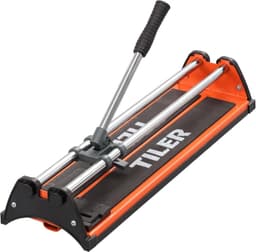
A tile cutting machine on amazon.co.uk is one of two families. A manual rail scores a line with a tungsten carbide wheel and then snaps the tile over a breaker. An electric diamond cutter grinds through the body, usually with water on the rim. Those are different purchases, even when both pages use the word machine. In this set the rails are the TILER 430 mm at £40.99, the BLOSTM 430 mm at £25.99, the MasterWorks 430 mm at £29.99, the ROJOO 600 mm at £109, and the TILER 1200 mm at £225. All five are hand powered. The electric side is the Vitrex Torque Master table saw at £59.95, 240 V and 450 W, and the MXBAOHENG handheld at £99, printed 220 V with no review line. Diamond discs you fit to an angle grinder are not this comparison. Screwfix puts the same split in a buying guide: a rail only makes a straight cut. It cannot start in the middle of a tile, and it cannot cut a curve. If every cut on your board is a straight line that fits the bed, a rail is the quieter, drier tool. If you need an L around a pipe, a 45° bevel on a visible corner, or a plunge, you are shopping for a wet saw, not a longer rail. Porcelain thickness and wheel size sit on cutting porcelain tiles. Here the first job is to stop treating the two families as interchangeable.

Length, thickness, and diagonals

Measure the longest cut on the real tile, not the shop name. A 600 mm square needs a 600 mm bed if you only ever score a side. The same tile laid at 45° needs about 850 mm on the diagonal. A 430 mm rail cannot score either line in one pass. The three short rails in this set all state 430 mm and 12 mm, and the TILER 430 mm listing says it is not compatible with large-format tiles. The ROJOO listing is the 600 mm bed at £109, with a thickness band of 6–15 mm. That clears a 600 mm side. It does not clear an 850 mm diagonal. The TILER 1200 mm states 1220 mm and 16 mm, which is the only rail here that can span that diagonal, at 18 kg and £225. Some reviews on the 430 mm TILER page describe a 630 mm cutter, and some on the ROJOO page describe a 48 inch machine. Those sentences are not the tables you are buying. Thickness is the second number, not a footnote. BLOSTM and MasterWorks exclude granite and marble and stop at 12 mm. The TILER 1200 mm claims 16 mm and marble. The ROJOO band starts at 6 mm, so a thin wall tile sits inside it, and a 16 mm floor tile does not. Do not average those figures into a universal porcelain rule. If the tile in your hand is thicker than the listing, you leave that rail, even if the stars look friendly.

Straight snap or a shaped cut

A longer rail still cannot notch. That is the point people miss after they have bought enough millimetres. An angle fence on a rail only turns the score across the face. The TILER 1200 mm states a 0–60° guide; that is a turned straight line, not a bevel cut through the thickness. Screwfix is blunt: manual cutters cannot make bevels. Shaped work in this set belongs to the Vitrex table. The bullets list a flip-up table for 22.5° and 45° mitres, a splash guard, and a water re-circulation tray. Reviewers also say the table is small, and 600 mm square porcelain is called out as a mismatch. So the wet saw is the right family for a notch or a visible mitre, and it is the wrong family if you hoped one £60 saw would replace a 1200 mm rail on long planks. The MXBAOHENG is a handheld 1300 W cutter with two 115 mm blades and a 5 m hose. It is not a table and not the default electric answer. If you only have budget for one tool and the board is all straight snaps that fit a 430 mm or 600 mm bed, buy the rail. If the board is full of pipe collars and boxed-in cisterns, buy the wet saw and accept that long straight cuts will be slow. The contrast, with hire as a third path, sits on manual tile cutter or wet saw.

Mains, water, and dust

Manual tools need no socket. That is why a 430 mm rail at £25.99–£40.99 is the low-dust option for straight ceramic. A powered cut on silica-bearing tile is a different job. HSE expects water on the blade for that work, and still expects you to think about RPE at APF 20 where the task is high risk. Wet cutting is not zero exposure. Do not dry-sweep the slurry. UK mains are 230 V nominal with a BS 1363 plug. The Vitrex listing states 240 V AC and 450 W, which matches a UK socket. The MXBAOHENG listing prints 220 V and 1300 W and does not state a BS 1363 plug. That is a buying problem, not a footnote. The Electrical Equipment (Safety) Regulations 2016 cover mains-voltage tools. PUWER 1998 applies to work equipment, including hire, not to a private householder tiling their own bathroom. A domestic listing is not a PUWER certificate. Hire is context, not a substitute amazon price. A Hodgson 1000 mm wet saw is noted at £44 for one day, excluding VAT. That figure is useful when you have one day of large-format porcelain and no wish to own an 18 kg rail. It is not a reason to treat the Vitrex as a 1000 mm saw.

A short checklist

Work through the five checks in this order. First, write down the longest cut, including any diagonal, in millimetres. Second, mark whether every cut is a straight snap, or whether you also need a notch, an L, or a 45° bevel. Third, read the listing’s length and thickness against the tile in your hand, and ignore reviews that describe a longer cutter. Fourth, if the tool is powered, check 240 V and a UK plug, and plan water plus slurry, not a dry disc. Fifth, decide whether one bathroom is cheaper as a £60 saw or a day’s hire, rather than as a £225 rail you will store in a loft. If the first check already fails a 430 mm rail, stop reading the 5.0 from four BLOSTM reviews. If the second check is full of notches, stop hunting for a longer rail. If the tiles are porcelain and the first offcuts chip, leave this page and read the porcelain note before you buy a second wheel. The comparison table stays on the main page. This checklist is only the order.

Common questions

How long a cutter do I need for 600 mm tiles?
A 600 mm side needs a bed of at least 600 mm, which in this set is the ROJOO rail. A 600 mm tile laid on the diagonal needs about 850 mm, which only the TILER 1200 mm can span here. A 430 mm rail cannot score either line in one pass.
Does a diagonal cut need a longer bed?
Yes. The diagonal of a square is longer than the side. Screwfix and ManoMano both flag that. Measure the diagonal on the tile you will actually lay, then read the listing length. An angle fence does not add millimetres to the bed.
Is a manual rail enough if every cut is straight?
Yes, if the tile also fits the length and thickness on the listing. Rails in this set run from 430 mm at £25.99–£40.99 to 1200 mm at £225. They still cannot start mid-tile or cut an L. Porcelain that will not snap is a material problem, not a reason to ignore the length check.
When do I need a wet saw instead?
When you need a notch, a curve, a plunge, or a 45° bevel, or when a rail inside its own limits has already failed the snap. The Vitrex is the 240 V table in this set. It is a small saw. It is not a 1200 mm bridge.
What does 240 V versus 220 V mean on a UK socket?
UK sockets are 230 V nominal with a BS 1363 plug. The Vitrex states 240 V. The MXBAOHENG states 220 V and does not print a UK plug. Check the plug on arrival. A Schuko-only lead is a return, not an adaptor job for a wet saw.
Are diamond discs part of this comparison?
No. An angle-grinder disc is a different category. The machines here are rails and two electric cutters with their own blades. Do not treat a 115 mm disc on a grinder as a tile cutting machine from this table.
Is hiring a 1000 mm saw cheaper for one day?
It can be, if you have one day of large-format work and nowhere to store an 18 kg rail. Hodgson’s 1000 mm wet saw is listed at £44 for one day, excluding VAT. That is hire context, not an amazon.co.uk price for these ASINs.

Related pages

Sources

Public UK sources used for this comparison. Listing prices, stars and review counts are the amazon.co.uk figures saved for this set on 19 October 2026.

  1. HSE — cutting roofing tiles (retrieved 19 October 2026)
  2. HSE — wet cutting (retrieved 19 October 2026)
  3. HSE — PUWER overview (retrieved 19 October 2026)
  4. GOV.UK — Electrical Equipment (Safety) Regulations 2016 (retrieved 19 October 2026)
  5. Screwfix — tiling tool buying guide (retrieved 19 October 2026)
  6. Walls and Floors — which tile cutter (retrieved 19 October 2026)
  7. Wickes — how to cut tiles (retrieved 19 October 2026)
  8. Topps Tiles — cutting tiles (retrieved 19 October 2026)