Independent comparisons. We may earn from shop links. More info

Nibbler buying guide

Updated: October 2026

You have a sheet on the bench and a page of watts, stroke counts, and star ratings that do not say whether the punch will enter the metal. A nibbler buying guide has to settle thickness and shape first, because a 30,000-stroke claim will not rescue a die that jams on a rib. The order is the millimetre rating for that metal, then flat sheet versus profile, then drill, battery, or air. The twelve cards and the GBP prices sit on the [nibbler comparison](/hub/cutting-tools/nibbler). We did not run a lab test. A qualifying purchase through an amazon.co.uk link can earn us a commission at no extra cost to you.

You have a sheet on the bench and a page of watts, stroke counts, and star ratings that do not say whether the punch will enter the metal.

Our top picks

On this page

Start with the sheet, not the motor

A nibbler is only as useful as the groove that takes the sheet. Makita’s DJN161 instructions allow 1.6 mm steel only up to 400 N/mm², 1.2 mm steel up to 600 N/mm², and 2.5 mm aluminium up to 200 N/mm². If the panel is harder or thicker than the groove, you stop. Stainless in this set is usually 1.0–1.2 mm, thinner than the mild-steel line. Read the unit the listing printed. DYXDYC states 20 gauge steel and 16 gauge aluminium, with no millimetre conversion. DEYITONG prints a 2.0 mm size field, then aluminium at 0.098 inches and stainless at 0.048 inches. Those are separate claims. An 800 W line on a bare 18 V body is not a checked capacity.

Flat sheet and profiled sheet are different purchases

DoublleHui excludes bent, ribbed, profiled, and welded plate. Axelrivet prints 1.6 mm carbon steel and says it is not suitable for corrugated steel. Funnytek allows flat sheet under 1 mm. A flat die on a box-profile crown jams or walks, which is what UK reviews of the DYXDYC adapter report on light-gauge roofing. Fujiwara names corrugated material, and UK reviewers mention 0.7 mm roofing. That is not a measured crown height. The Makita file does not print a profile rating; cladding comments are not a throat depth. Coated box profile belongs on the nibbler for roofing sheets page. A short flashing may still be tin snips, which is the split on the nibbler vs tin snips page.
Makita Makita DJN161Z 18 V nibbler

Testsieger

Makita Makita DJN161Z 18 V nibbler
7.5/10about £267.99

Drill, battery, or air

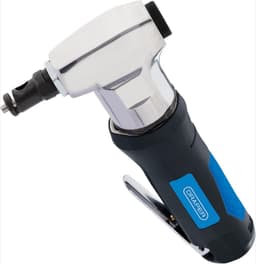
A drill attachment has no motor. Force depends on chuck grip and, on several listings, a 1,500–3,000 rpm band. Fujiwara reviewers say the spindle is short and must be centred, and that a keyless chuck can bind. The cheap end is about £12.53–£17.63. Fujiwara is about £31.99 with spares in a box. That suits one thin flat sheet if you already own a keyed drill. It is a poor default for a day’s cladding. Cordless bodies here are sold bare, from about £73.99 to the Makita DJN161Z at about £267.99, battery extra. “Makita compatible” is not a Makita tool, and non-genuine packs invalidate the Makita guarantee. The Draper 70835 is about £35.56, rated to 1.5 mm steel, only if you already run a compressor. The listing omits pressure and air use, and reviews say the connector is not a standard 1/4 inch BSP fitting.

Kerf, radius, and spares

A nibbler punches a strip out. ManoMano describes electric punch widths of about 3–8 mm. One UK review of the DEYITONG body reported about 6 mm removed. Mark the finished edge after that waste. Makita’s minimum radius is 45 mm inside and 50 mm outside. Some drill kits claim 12 mm. A tighter notch is a snips job. Fujiwara and Axelrivet kits include extras. Makita’s carton does not. Consumer Rights Act 2015 still covers goods that are not as described when a unit will not cut the thickness on its own page. Who should skip the remaining match is on the best nibbler page.

Common questions

What thickness of steel can a nibbler cut?
Only the millimetre line for that metal. Several drill attachments print 0.8–1 mm steel plate. Draper prints 1.5 mm steel. A “2 mm or 14 gauge” claim is not a stainless figure. If the sheet does not enter the groove, do not cut it.
Why is stainless rated thinner than mild steel?
Stainless is stronger, so the same punch is rated thinner. Makita’s instructions tie 1.6 mm steel to 400 N/mm² and 1.2 mm steel to 600 N/mm². A single “2.0 mm” line is not a stainless rating.
Does a higher wattage or stroke count mean a thicker cut?
No. Gautesy claims 30,000 strokes per minute beside a thickness band similar to tools at 1,900 strokes. Capacity is the millimetre rating for that metal, not the number above it.
Should I buy a drill attachment or a bare 18 V body?
A drill attachment is a chuck and no motor, at about £12.53–£31.99 here. It suits one thin flat sheet if you already own a drill. A bare 18 V body starts at about £73.99 and still needs a battery. Buy the body when you already own the packs and the job repeats.
What does body only mean for the price?
Every cordless row excludes the battery and the charger. Makita’s listing says non-genuine batteries invalidate the guarantee. Add that cost before you compare a bare body with a £32 drill kit.
When is an air nibbler the wrong saving?
When you do not already have a compressor, or when the listing omits pressure and a standard inlet. Reviews say the Draper connector is not a standard 1/4 inch BSP fitting. That is a workshop tool, not a cheaper cordless.

Related pages

Sources

Public UK sources used for this comparison, last checked in October 2026.

  1. HSE INDG291, provision and use of work equipment (retrieved October 2026)
  2. HSE, selecting equipment to control vibration (retrieved October 2026)
  3. Supply of Machinery (Safety) Regulations 2008 (retrieved October 2026)
  4. GAP Group, Makita DJN161Z cordless nibbler (retrieved October 2026)
  5. Tooled Up, nibblers vs shears (retrieved October 2026)
  6. Colour Clad Profiles FAQs (retrieved October 2026)
  7. Sealey SNA9821 drill-attachment instructions (retrieved October 2026)
  8. Consumer Rights Act 2015 (retrieved October 2026)