Straight cut plasma cutter: use a guide and a strip

A wavy plasma edge comes from the gap, the speed or the kerf. Practise on a matching strip, use a roller only if the box has one, and stop if the arc drops.
On this page

You marked a bracket, pulled the trigger, and the edge came back as a shallow wave. A straight cut plasma cutter can follow a line, but the first edge usually fails for a reason you can see on the scrap: the gap under the tip changed, your speed changed, or the slot took more metal than the mark allowed. Air, earth and when to stop belong with machine setup.
The Products Compared editorial team used amazon.co.uk listings from the Stahlwerk plasma cutter comparison, including the included-accessories lines and UK reviews, plus R-Tech Welding's public technique page. We did not run a lab test, and we did not measure a kerf. Prices are shelf prices from those listings, in GBP, and they can move. Links to amazon.co.uk use the tag pcuk26-21. A qualifying purchase can earn a commission at no extra cost to you.
The comparison's top pick is the Reboot CUT60, listed at about £132.04 and rated 4.6 from 28 reviews. The title states a 12 mm clean cut and touch-arc ignition. A bullet adds a 16 mm maximum and a 35% duty cycle. The included list names a PT31 torch and a roller. Air is given as 30–70 psi, and the box does not include a compressor. Technical details state 240 V. The wider set is the Stahlwerk plasma cutter comparison.
In short
A straight edge comes from a practice strip of the same thickness, a gap you can hold, and a speed that matches the current. Use a roller only when that torch's listing or box includes one, and stop if the arc cuts in and out. Kerf is the width the plasma removes, so measure a practice slot on your own metal.
A straight line is a setup, not a steady hand alone
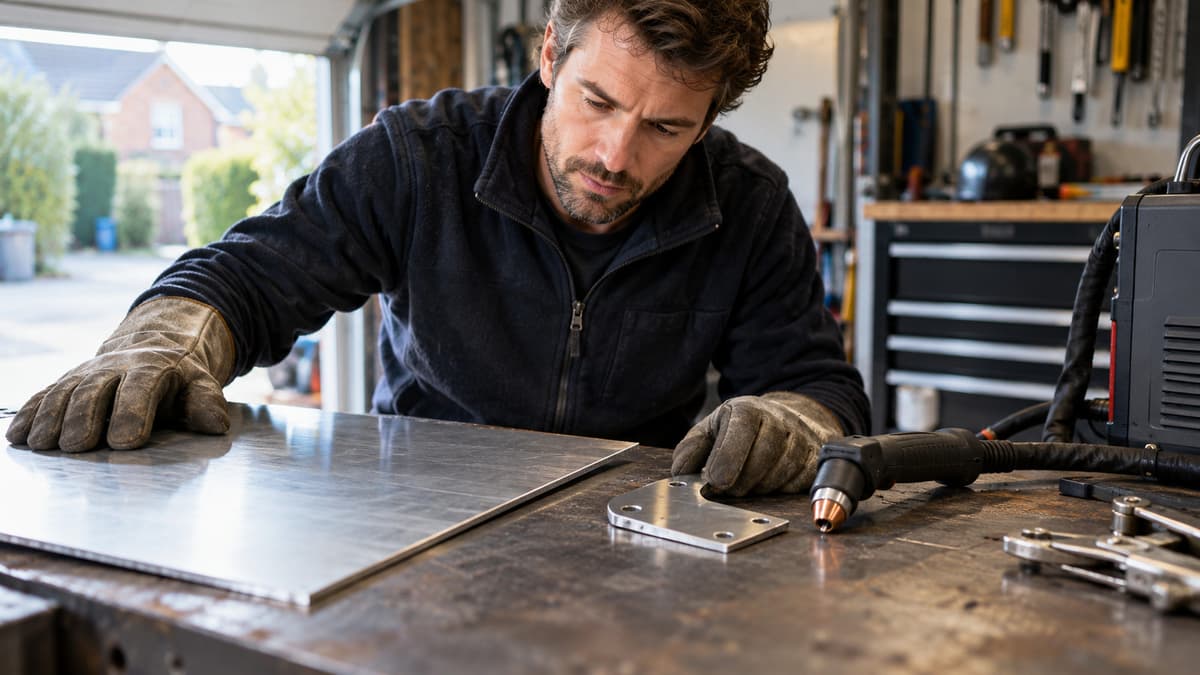
A steady hand still wanders when the torch is short, the cable tugs, and the arc hides the mark. Set the plate so it cannot bounce, put the earth clamp on bare metal, and mark the line where you can still see it beside the tip. Face the direction of travel before you press the trigger.
On a long edge, stand so your forearm can cover the whole line without a step in the middle. If you have to shuffle, release the trigger, move, and pierce again rather than dragging a kink into the piece you mean to keep. The second pierce leaves a small hole, which is easier to dress than a wave along the full length.
R-Tech Welding's plasma cutting guide treats cutting speed, amperage and tip size as one choice. The page is written for R-Tech torches. Do not copy a tip size from it onto a PT31 or an AG60. The SPRIGHOLLY CUT50L listing names an AG60. A PT31 is a different part, fitted on the Reboot CUT60. Fit the consumable your own torch manual names.
A calm speed on 1–2 mm sheet is a different job from the same speed on thicker plate. The current that severs thin sheet can leave only a scar on plate, and the current that suits plate can blow a wide slot in sheet.
Gap, speed and the practice strip
Drag means the tip, or a drag shield the manual specifies, rides on the plate. Stand-off means you hold a gap and keep it constant. Your torch manual decides which you are doing. A listing that never mentions a drag shield does not put one in the box.
One UK review of the touch-start SPRIGHOLLY CUT60, on 1–2 mm metal, called a 0.5 mm gap critical and said a guide made it easier to hold. Freehand became acceptable after practice. That 0.5 mm belongs to that review and that thin metal. Do not copy it onto 6 mm plate or a different torch. We did not measure it. If your manual states another gap, the manual wins.
Travel too fast and the arc fails to finish the cut, so you slow down, the slot widens, and the edge waves. Travel too slow and dross piles on the underside. On scrap, change current or speed, not both at once, then look at both faces. Use a strip of the same thickness and the same metal. A mild-steel strip does not tell you how 3 mm stainless will behave.
- Support a practice strip of the same thickness, with room for the offcut to fall so the slot does not pinch the tip.
- Fit the tip and electrode your manual names, and start at a low current.
- Mark a line you can see beside the tip, and decide whether you are dragging or holding a stand-off.
- Travel at one speed. If the metal does not drop through, change current or speed on the next strip, not both.
- Keep the strip. The slot width is the allowance for the real bracket.
On a full-length edge the cable pulls in a way a short strip never shows. Make one waste cut on the real sheet first. If that cut wanders where the cable changes direction, fix the cable path before you blame the tip.
A roller, if the box has one
A plasma cutter roller holds the torch at a set height along a straight edge. It keeps the gap. It does not aim the cut. A crooked fence, or a torch twisted off vertical, leaves the mark even when the wheel stays on the fence.
Only two listings in this set claim a guide. The touch-start SPRIGHOLLY CUT60, at £87.35 and 3.3 from 9 reviews, mentions a roller guide on a PT-31 with a 3 m cable. The Reboot CUT60 includes a PT31 roller and a consumables kit. The SPRIGHOLLY CUT50L lists an AG60, at £67.83 and 5.0 from 2 reviews, and does not mention a roller. Two reviews are a thin sample. With no wheel, clamp a straight rule on one side of the line and allow for the torch body.
R-Tech treats a circle as its own technique. A roller does not set a radius. Sight along the fence before you strike the arc. Daylight under a straightedge means pick another piece.
Kerf, and why the bracket did not fit
Plasma cutter kerf is the width of metal the arc removes. The slot is empty. A cut centred on the finished scribe leaves the part small. Two parallel cuts can make a tab miss a bolt. There is no kerf figure on this page, because none was measured, and a listing photo is not a measurement.
Measure the practice slot with the rule you will use on the job. Offset the real line by that amount on the waste side. Offset both sides of a tab, in opposite directions, or it comes out narrow by two slots. Write the millimetres on the strip. Offer the outer shape up before you pierce holes in it. A worn tip widens the slot, so measure again if the edge suddenly opens up.
When the arc is the problem
A wave that follows your arm is stance and fence. A wide, tilted or drossy edge, while the torch stayed on a straight fence, is current, air, tip or the metal. A UK review of the SPRIGHOLLY CUT60L PRO described a messy edge on 3 mm stainless at the default 15 A. The reviewer suspected more air and more current. That is one review, on stainless. The listing states a 10 mm clean cut and 16 mm severance on mild steel, at £159.99 and 4.0 from 7 reviews, and it asks for a compressor at 0.4 MPa and 60 L/min, which is not in the box. The CUT50L asks for 90 PSI and 60 L/min, also not included.
If the arc cuts in and out, stop. A cut that starts and dies is no longer a line you can correct with a steadier hand. Follow the stop rules on the how to use a plasma cutter page. Do not force the cut because a title printed a thickness. Those figures are listing claims.
A touch-start CUT60 review said paint has to be cleared at the tip and at the earth clamp. That is part of a continuous cut. It does not make a closed garage a sensible place to cut painted or galvanised steel. If the second strip is still a mess after thickness, current and a true fence match, the fault is in the arc or the air.
Common questions
How do I cut a straight line with a plasma cutter?
Should I use a plasma cutter guide or cut freehand?
What gap should I leave under the tip?
Why does a plasma cutter wander off the line?
What is plasma cutter kerf?
Does every plasma torch include a roller?
Why was my first 3 mm cut a mess?
Can I cut a circle with the same roller?

Products Compared publishes British-English buying guides based on amazon.co.uk listings and public UK sources. We do not run a lab and we do not invent test scores.
Related articles

Plasma cutter consumables: tips that change the edge
A worn tip widens the slot. Check what the listing included before you blame your line.

Clean cut versus severance on a plasma cutter
A title can print two thicknesses. The clean cut and the severance cut are different jobs.
Cutting stainless and aluminium at home
Stainless and aluminium claims shrink once you leave mild steel. Here is what this set shows.