Independent comparisons. We may earn from shop links. More info

100 litre air compressor buying guide

Updated: 21.10.2026

A 100 litre tank stores air. It does not tell you whether a nailer, a blow gun, or a spray gun will keep working once the trigger stays down. If you are fitting a home garage or a small workshop in the UK, this 100 litre air compressor buying guide puts free air delivery first, then the tool, then oil, noise, and footprint. The four machines kept from amazon.co.uk are direct-drive piston compressors, and the cards and shelf prices sit on the [100 litre air compressor comparison](/hub/compressors/100l-air-compressor). The figures below come from those amazon.co.uk listings and the manufacturer pages named in the sources. There is no lab test.

A 100 litre tank stores air. It does not tell you whether a nailer, a blow gun, or a spray gun will keep working once the trigger stays down.

Our top picks

TIGREN TIGREN V100DD 100L

Best overall

TIGREN TIGREN V100DD 100L
6.7/10about £347.99
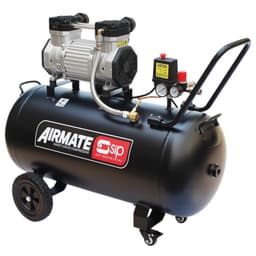
SIP SIP Airmate 100L horizontal

Alternative

SIP SIP Airmate 100L horizontal
5.7/10about £395.96
SIP SIP Airmate 100L vertical

Rank 3

SIP SIP Airmate 100L vertical
7.2/10about £479.98
On this page

Airflow before litres

Free air delivery is the volume the pump puts out at a stated pressure. Displacement is the theoretical sweep of the piston, and it is the larger number. In this set, only the SIP Airmate vertical, model 05484, states both figures on the amazon.co.uk bullets: 9 CFM free air delivery at 8 bar, and 13.6 CFM displacement. The other three need a manufacturer page before the airflow number is usable. SIP's page for the horizontal Airmate 05481 states 9 CFM free air delivery. Amazon's cell on that listing says 15 CFM and does not call it free air delivery, so 15 CFM is the wrong figure for a nailer or a gun. Sealey's sheet for the SAC10030VA states 7 cfm free air delivery. The Amazon title's 13.7 cfm is unlabelled. SIP's page for the TIGREN V100DD states 8 CFM free air delivery, against 13 CFM unlabelled on Amazon. Read together, the usable band is about 7 to 9 CFM at the pressure the maker names, although every title says 100 litres and about 3 hp.

What 100 litres is for

The receiver lets the pump rest between short bursts. Nailers, tyre inflation, and a blow gun used in clicks fit that pattern: the tank covers the spike, then the pump refills. A spray gun or a die grinder held open asks for air for as long as the trigger is down. When that demand is higher than free air delivery, pressure falls until the tool falters, and 100 litres only delays the fall. The litre number does not quieten the pump or raise the cut-out. Both SIP Airmate listings are oil-free. The Sealey and the TIGREN are oil-lubricated once you read the manufacturer pages, which matters if you spray. That choice is on the oil-free or oil page. TEH's TAC100L is a 100 litre machine with about 10.6 CFM free air delivery at 8 bar, built for a 32 A supply. It is not one of the four listings in this comparison. It shows why 100 litre is not a performance grade you can shop by.
TIGREN TIGREN V100DD 100L

Testsieger

TIGREN TIGREN V100DD 100L
6.7/10about £347.99

Plug, pressure, and the workplace receiver

UK mains are 230 V, and a normal socket is a BS 1363 13 A outlet. The vertical SIP listing includes a 1.3 m cable with a 13 A plug and states 13 A. The horizontal SIP also states 230 V and 13 A. The TIGREN listing states 230 V and a current of 9.73 A. The broader pattern for this 2.2 kW class is a 13 A circuit, so plan the socket from the plug the machine is built for. Sealey's Amazon page does not state voltage. Sealey's instructions for the SAC10030VA specify a 13 A plug and say extension leads are not recommended. Maximum pressure on the SIP and TIGREN listings is 8 bar, which is 116 psi. The Sealey title says 116 psi. The technical table's maximum pressure 1 has no unit, so leave that cell alone. Eight bar is the region where the pump cuts out. The regulator sets the tool. It does not raise the cut-out. At work, a 100 litre receiver at 8 bar is 800 bar litres, above the 250 bar litre example in HSE INDG178, so an employer should expect a written scheme from a competent person.

What to ignore on a listing

Three fields in this set will send you to the wrong machine if you trust them raw. The Sealey Amazon dimensions of 10 × 10 × 10 mm are not a compressor. Sealey's own sheet gives 1040 × 350 × 720 mm and 48 kg nett, against 62.5 kg on Amazon. Use the sheet for size and weight. Do not average the two figures into a third number nobody published. The same sheet states 97 dB. Amazon's quiet operation bullet has no decibel beside it. Those classes are on the garage noise page. The vertical SIP's model-name field says 2 hp. The title and the maker say 3 hp, which is the 2.2 kW line. Buy against 2.2 kW. The horizontal SIP's 15 CFM cell and the Sealey title's 13.7 cfm stay unlabelled until a page calls them free air delivery. If the tool's plate sits above about 9 CFM and you will hold the trigger open, this set is the wrong class even though every tank says 100 litres.

Common questions

What should I check before the tank size?
Check free air delivery at a stated pressure, then the tool's own air demand, then the plug. In this set the labelled free-air figures, some of them on the maker's page rather than on Amazon, sit around 7 to 9 CFM. The 100 litre tank stores that air between bursts. It does not increase what the pump can deliver while a gun stays open. A 25 to 30 per cent margin over the tool is a rule of thumb from a retailer guide, not a legal minimum.
Is 9 CFM free air delivery enough for nailers?
For intermittent nailers and tyre work, 9 CFM free air delivery at about 8 bar is the class these pumps offer, and it covers many home nailers whose own plate sits well below that. Leave about a quarter in hand as a rule of thumb. A nailer used all day on a site, or a tool that asks for more than the pump can deliver, needs a different machine. The tank size does not change that sum.
Will a 100 litre tank let me spray a car panel for a long time?
Only if the gun's air demand sits inside the pump's free air delivery. A 100 litre receiver gives you a reserve, then the pressure follows the pump. The labelled figures here are about 7 to 9 CFM. A multi-bay guide that asks for 14 to 20 cfm is describing a larger compressor, not a bigger tank on one of these four. Oil mist is a separate problem if you spray with a lubricated pump.
Can I run a 3 hp compressor from a normal UK socket?
The SIP listings that state a supply say 230 V and 13 A, and the vertical model includes a 13 A plug. Sealey's instructions for the SAC10030VA also specify a 13 A plug and advise against an extension lead. A 3 hp or 2.2 kW name on a direct-drive compressor is not, by itself, a 32 A machine. TEH's 100 litre model on a 32 A socket is a different product. Use the wall socket the maker designed for, and keep the lead short.
Do I need a written scheme at home?
If you have no employees and the compressor is private hobby use, the written-scheme duty in the Pressure Systems Safety Regulations 2000 does not fall on you. If staff use the receiver, a competent person should draw up the scheme before use. A 100 litre tank at 8 bar is 800 bar litres, above the 250 bar litre example in HSE INDG178. At home you still drain the tank, and you still stop if the shell is damaged or the safety valve lifts.
Why do two CFM numbers appear on one listing?
The larger number is usually piston displacement. The smaller number, when it is labelled free air delivery at a pressure, is what reaches the tool. On the vertical SIP the bullets give both: 13.6 CFM displacement and 9 CFM free air delivery at 8 bar. On the horizontal SIP, Amazon's 15 CFM is unlabelled, and SIP's page states 9 CFM free air delivery. Size the tool on the labelled free-air figure.

Related pages

Sources

Public UK sources and manufacturer pages below. amazon.co.uk listings checked on 20 October 2026.

  1. HSE INDG178: Written schemes of examination (retrieved 20 October 2026)
  2. Pressure Systems Safety Regulations 2000, regulation 8 (retrieved 20 October 2026)
  3. HSE: Noise at work, employers (retrieved 20 October 2026)
  4. Control of Noise at Work Regulations 2005, regulation 4 (retrieved 20 October 2026)
  5. GOV.UK: Pressure Equipment (Safety) Regulations 2016 (retrieved 20 October 2026)
  6. BCAS fact sheet 851 (retrieved 20 October 2026)
  7. Sealey SAC10030VA product page (retrieved 20 October 2026)
  8. Sealey guide to compressors (retrieved 20 October 2026)